
Want to hear the full story from the man who literally wrote the book on corporate breakthroughs? Go to YouTube and listen to the podcast episode here: Podcast
We are operating in an era of unprecedented industrial and digital acceleration. If you are reading this, you are likely an entrepreneur, a founder, or a strategic business leader operating within mature industries, feeling the intense margin pressure and relentless competition of the modern marketplace right from the start. You know that standing still is a death sentence. But what happens when your core business matures? What happens when the explosive growth of your startup phase settles into the predictable, yet vulnerable, reality of a mature enterprise?
The default corporate reflex to margin pressure is cost-cutting, optimization, and leaning heavily into what already works. However, as the business landscape pushes through 2026, relying solely on operational excellence is a guaranteed path to irrelevance. Innovation is not just a buzzword to throw around in board meetings; it is the fundamental mechanism for strategic renewal.
In a recent, highly revealing episode of The Business Narrative you can explore our full library of entrepreneur interviews here, we sat down with Bruce Vojak—Managing Director of Breakthrough Innovation Advisors, former Dean at the Grainger College of Engineering, and author of Serial Innovators and No-Excuses Innovation. Vojak’s decades of experience working with mature titans like Hewlett-Packard, Procter & Gamble, and Motorola highlight a profound reality: true innovation is a deeply personal, human act of discovery.
This comprehensive guide deconstructs Vojak’s insights, cross-referenced with decades of market data, to provide you with the ultimate blueprint for sustaining breakthrough innovation in mature industries. We will explore how a simple carrot farmer revolutionized a stagnant agricultural sector, and why your multimillion-dollar AI investment is likely destined to fail if you lack the right human capital.
What is a Serial Innovator?
To win the digital landscape, we must clearly define our terms.
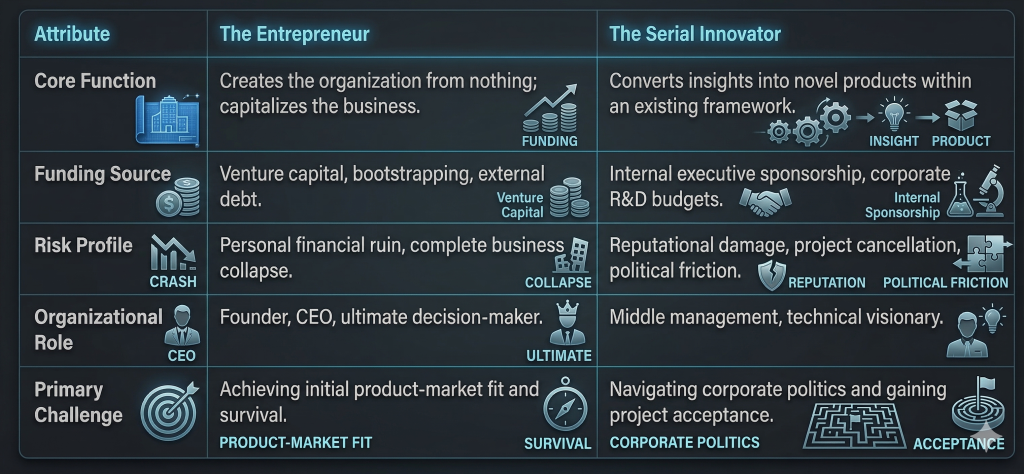
What is a Serial Innovator? A serial innovator is a highly motivated professional within a mature organization who repeatedly identifies unarticulated customer problems and navigates internal corporate politics to commercialize breakthrough products. Unlike independent entrepreneurs, serial innovators utilize existing corporate resources and executive sponsorship to drive strategic renewal and generate millions in revenue without carrying personal financial risk.
The 2026 Macro Environment: The Innovation Readiness Gap
Before we can build an army of serial innovators, we must understand the battlefield. The macroeconomic environment shaping industry growth through 2026 differs fundamentally from previous cycles. Global GDP growth hovers around 3.2%, yet specific technology-driven sectors are experiencing 15-40% compound annual growth rates.
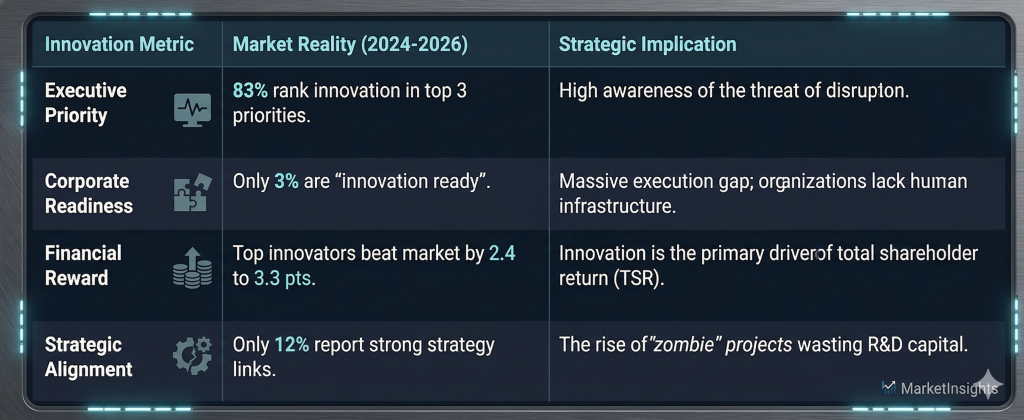
Despite these opportunities, corporate readiness is plummeting. According to a comprehensive 2024 study by the assessing over 1,000 senior executives globally, a record 83% rank innovation among their organization’s top three priorities. Yet, shockingly, only 3% of these companies actually qualify as “innovation ready”—a steep and terrifying drop from 20% just two years prior.
The Illusion of Progress: Zombie Organizations
What causes this massive disconnect? BCG researchers identified the phenomenon of “zombie organizations.” These are companies that maintain a high volume of active projects in their development funnels, merely going through the motions of innovation without a clear strategy linking these efforts to actual business outcomes. Less than half (48%) of executives feel their organization makes any real effort to link business and innovation strategies, and a mere 12% report strong links that deliver real impact.
The cost of this readiness gap is staggering. A portfolio invested in BCG’s top 50 most innovative companies consistently beats the MSCI World index by more than 3.3 percentage points per year. Top innovators outperform the broader market by an average of 2.4 percentage points annually, particularly during periods of crisis like the Great Recession and the COVID-19 pandemic.
Institutional Drift and the Need for “Refounding”
This lack of alignment inevitably leads to institutional drift. A sweeping 2024–2025 study conducted by the observed nearly 200 in-depth CEO interviews, noting that within a twelve-month period, five iconic companies—including Nike, Starbucks, Boeing, and Intel—replaced their CEOs due to an erosion of their distinctive character.
As Bill Gates remarked, “I am stunned that Intel basically lost its way”. The Yale study reveals that conventional turnaround playbooks (restructuring, portfolio reshaping) fail when a company has lost its core identity. Mature companies must engage in “refounding”—recovering their enduring organizational truths and reinterpreting them for a changed world. This refounding cannot be outsourced to consultants; it requires the internal, relentless drive of serial innovators.
The Fundamental Conflict: The Innovator vs. The Entrepreneur
If you are a founder reading this, you likely view yourself as the ultimate innovator. However, the business ecosystem frequently conflates the terms “entrepreneur” and “innovator,” leading to catastrophic misallocations of talent. As Steve Blank noted, these are not points on a spectrum; they are two orthogonal skills.
During our conversation, Bruce Vojak illuminated the critical differences in how these two archetypes operate, how they are funded, and the unique risks they carry.
The Entrepreneur: Building from the Ground Up
The entrepreneur is the architect of the organization. They create companies from nothing. They build the initial team, capitalize the business, ship the first product, and close the foundational deals necessary to create a viable entity.
The risk profile of an entrepreneur is absolute. They rely heavily on external funding—venture capital, angel investors, or bootstrapping—to make things happen. An entrepreneur might risk their entire livelihood, mortgage their house, and sacrifice their personal financial stability for the venture.
The statistical reality of this risk is brutal. While it is a myth that 90% of businesses fail in their first year (approximately 79.6% actually survive year one), the long-term attrition rate is severe. Only 50.6% of businesses survive five years, and a mere 34.7% survive ten years. In the technology sector specifically, the failure rate hits 63% within five years. Crucially, 42% of startups collapse simply because they misread market demand and created a product nobody wanted or needed.
The Serial Innovator: Navigating the Mature Enterprise
Conversely, the serial innovator operates within the confines of an existing, mature organization. They are typically not the CEO or the founder; they reside in the middle management layers. Their role is to convert insight into something novel—a distinct new product, a fresh approach, or a new angle on an old problem.
Serial innovators do not mortgage their homes. Instead of seeking external venture capital, they look for internal funding from executive-level sponsors. Their risk is reputational and political. If they fail, they do not bankrupt a company; they lose internal credibility, their projects get cancelled, and they suffer career friction.
However, because they leverage the massive resources, supply chains, and capital of a mature firm, their successes are monumental. Individuals like Chuck House at Hewlett-Packard (who invented the logic analyzer) or Carol Bernick at Alberto Culver (who developed Mrs. Dash) are responsible for generating hundreds of millions of dollars in sustained corporate revenue.
The Generative AI Mirage: Why Tech Alone Won’t Save You
As we navigate 2026, there is a dangerous misconception spreading through corporate boardrooms. Executives, panicked by the innovation readiness gap, are attempting to buy their way out of stagnation by pouring billions of dollars into Artificial Intelligence (AI) and Machine Learning initiatives.
The implicit hope is that AI agents will automatically generate the breakthrough ideas required to secure future growth. The data, however, paints a terrifying picture of capital destruction.
The 95% Failure Rate of Corporate AI
A sobering 2025 study conducted by MIT, titled The GenAI Divide: State of AI in Business, reveals the brutal reality of enterprise AI adoption. Despite an estimated $30 to $40 billion invested in enterprise AI initiatives, a staggering 95% of corporate AI projects fail to produce any measurable financial returns.
Furthermore, widespread surveys indicate that over 80% of companies report zero productivity gains from their AI investments. While 86% of organizations boast that they are “experimenting” with Generative AI for innovation, a mere 8% have managed to apply it at any meaningful scale.
Why AI Fails at Breakthrough Innovation
Why is the failure rate so astronomical? Because corporate leaders are fundamentally misunderstanding the nature of innovation.
As Bruce Vojak notes, innovation is a deeply human and intensely personal act of discovery. AI is an extraordinary tool for optimizing existing processes (exploitation), generating permutations of known data, and accelerating code generation. However, AI relies on historical training data; it cannot intuit the unarticulated emotional or physical friction experienced by a human consumer.
An AI algorithm could optimize the supply chain for a straight-edge carrot peeling knife. It could generate a thousand variations of marketing copy for that knife. But an AI algorithm would never watch a woman with arthritis struggle in pain and intuitively realize that the solution was to attach the blade to a modified rubber broomstick.
When you use AI as a substitute for human discovery, you inevitably generate high volumes of low-risk, incremental noise. Without a well-executed human innovation strategy, dumping cash into technology merely results in an incredibly expensive iteration of the status quo.
The 2026 Playbook: How to Operationalize Breakthroughs
If AI is not the silver bullet, and incremental optimization leads to a Nokia-style collapse, how do you actively build an organization capable of delivering baby-carrot-level breakthroughs?
You must move from theoretical desire to structural execution. Based on deep analysis of mature technology firms and the frameworks of leading strategists, here is the actionable playbook for strategic renewal.
Step 1: Sensing and Seizing
The foundational process of rejuvenation begins with an exercise in “Sensing and Seizing”.
- Sensing: You must force your organization to look outward. What are the emerging threats, shifting customer desires, and cross-industry technological advancements? Simultaneously, you must look strictly inward to assess your current capabilities. The objective is to identify the precise gap between what your company has today and what the market will demand tomorrow. You must actively test your assumptions and accept that resting on past achievements is a lethal trap.
- Seizing: Once a gap is identified, you must commit capital and resources to address it. You do not need to be the first mover to win. Apple and Microsoft were not the first movers in smartphones or PCs, but they dominated because they made superior organizational choices regarding their operating models and internal structures.
Step 2: Empowering the Change Coalition
You cannot mandate innovation via a corporate memo. The most successful mature enterprises explicitly prioritize CEO commitment; the executive board must be visibly and passionately involved in the innovation journey.
However, you must delegate the operating authority to the middle layers of your organization where the serial innovators reside. Utilize John Kotter’s established methodology: create a profound sense of urgency, build a guiding coalition of cross-functional talent, craft a clear vision, and ruthlessly remove the bureaucratic obstacles that stifle your innovators.
Step 3: Vertical Thin Slicing for Quick Wins
The fastest way to kill an innovation initiative in a mature company is to attempt a massive, horizontal overhaul that takes years to show ROI. Stakeholders will lose patience, and the project will be cannibalized by the core business.
Instead, employ “Vertical Thin Slicing”. Break your massive, complex problem into a small, end-to-end feature that can be executed rapidly by a cross-functional team. Focus on generating small, immediate “quick wins” to build political momentum and demonstrate undeniable value to the skeptics within your organization. Success breeds ambition; these early victories act as stepping stones, increasing your organization’s appetite for managed risk and continuous learning.
Step 4: Institute Front-End Innovation (FEI)
Do not rely on chaotic, unstructured brainstorming sessions. The best mature companies implement a rigorous process for “Front-End Innovation” (FEI). This requires dedicating resources specifically to idea generation, rigorous selection criteria, and a structured mechanism for converting those raw ideas into tangible project development pipelines that directly link back to the overarching corporate strategy.
Final Thoughts: The Burden of Leadership
The statistics surrounding corporate survival are unforgiving, but they are not a prophecy. The 95% of executives who claim they lack the time to focus on long-term strategy are the exact leaders who will ultimately preside over obsolete empires.
Innovation in mature industries is never an accident. It is the result of disciplined habits, a culture that tolerates calculated risk, and the relentless pursuit of unarticulated customer assumptions. It requires leaders who are willing to protect their serial innovators from the crushing bureaucracy of the status quo.
The market does not care about your legacy. It does not care about how efficient your supply chain used to be. The only thing that guarantees your survival in 2026 and beyond is your capacity for strategic renewal.
(Check out our TBN to see more Blogs)


![Why Your Mouth Is the Ultimate Gateway to High Performance [2026 Guide]](https://thebusinessnarrative.net/wp-content/uploads/2026/09/Podcast_Thumbnail_94-1.jpg)
