
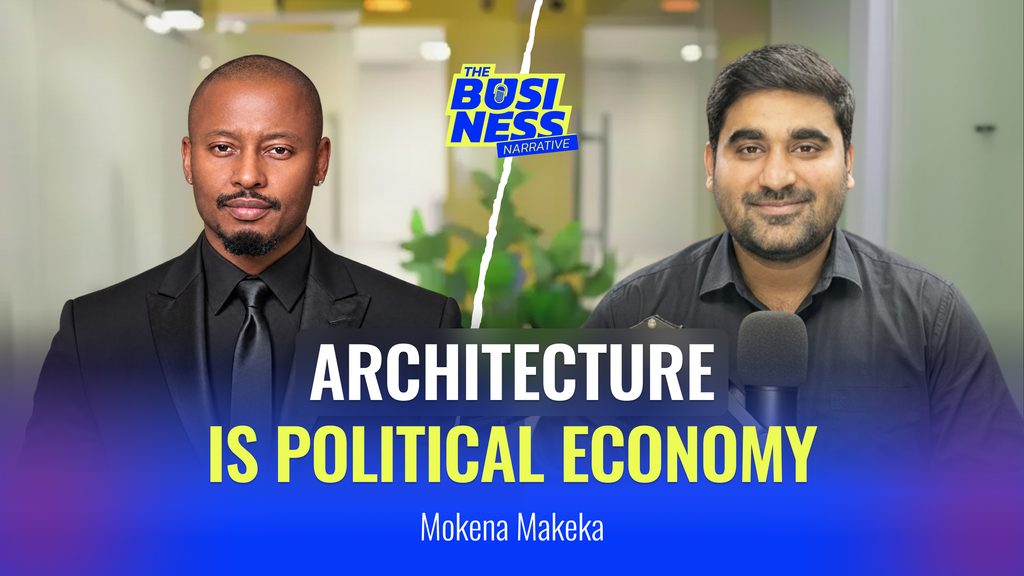
You’ve been sold a lie about following your passion. We all have. We’re told that if we just do what we love, the money, the impact, and the legacy will naturally follow.
But what happens when your passion requires immense suffering, and your natural gift lies somewhere completely different?
Want to hear the full story firsthand? Go to YouTube and listen to the podcast episode here: PODCAST.
We sat down with Mokena Makeka—founder of FLOW (Future of Living for One World), acclaimed architect, urbanist, and cancer survivor. Mokena dropped masterclass-level insights on the harsh realities of wealth in design, why he abandoned his first love of music, and how entrepreneurs can build businesses that actually sustain the planet.
If you want actionable truth without the fluff, you’re in the right place. Let’s break it down.
What is Regenerative Urban Design?
Regenerative urban design is a strategic approach to city planning that ensures human development operates strictly within planetary limits. It focuses on redesigning supply chains, energy sources, and material usage so that economic growth actively restores the environment rather than depleting it, creating sustainable ecosystems for future generations.
Why Should You Ignore Your Passion and Follow Your Gift?
Mokena started out wanting to be a musician. He had the connection with the audience, he could perform, and he loved the energy of elevating a room.
There was just one problem: it was a massive grind. Finding the right flow took endless takes and exhausting effort.
Architecture, on the other hand, was effortless for him. He could design in his sleep. His professors immediately recognized his genius, while his peers struggled to grasp the basics. Mokena realized a hard truth that every entrepreneur needs to hear: your passion and your gift are not always the same thing.
He made a strategic choice to stop feeding his ego with music and start serving society with his gift. When you lean into the thing you are naturally proficient at, you scale faster, you serve better, and your unique contribution to the market becomes undeniable.
Is Architecture Actually a Path to Obscene Wealth?
If you are entering the architectural space to become a billionaire, you need to pivot immediately.
Mokena shared advice from an early mentor that perfectly encapsulates the reality of the industry: architecture will give you a fantastic middle-class life. It will pay for great schools for your kids and provide stability. It will rarely make you obscenely wealthy.
Here is why the economics of architecture work this way:
- The Time Trap: It remains a fundamentally human activity, strictly bound by billable hours.
- The 99% Rule: 99% of architectural work is compliance-driven (shopping centers, cafes, basic infrastructure).
- The 1% Anomaly: Only the top 1% of the sector handles the glamorous, highly profitable projects like iconic skyscrapers and global museums.
Architecture is an expression of political economy. You do it to shape behavior and drive societal change—not to land on the Forbes 400.
How Can Entrepreneurs Protect the Planet While Scaling?
Mokena’s current focus with FLOW is tackling a terrifying metric: if everyone on earth lived the lifestyle of a first-world nation, we would need 5.2 planets to sustain it. We only have one.
Whether you are building cities or SaaS products, you are part of a supply ecosystem. To build a business for “One World,” you have to audit your footprint. Mokena outlines three practical steps we can all take to force the market to respond to better ecological choices:
- Audit Your Energy: Radically reimagine your energy sources. Subsidized oil creates a false sense of abundance. Pivot toward solar and natural energy wherever possible.
- Rethink Consumption & Waste: Artificial demand destroys ecosystems. Eat seasonally. When you demand off-season produce shipped across the globe, you are paying a hidden greenhouse gas tax.
- Leverage Density: Wealth often drives people to build massive, isolated estates. But human density in cities makes infrastructure, transport, and resource sharing vastly more efficient.
How Do You Lead Through Extreme Personal Adversity?
Mokena’s journey wasn’t just about professional pivots; it was tested by a brutal battle with cancer.
When you are building a legacy, life will inevitably hit you with uncontrollable variables. Mokena’s survival strategy is a blueprint for navigating absolute darkness:
- Refuse to Suffer in Silence: In many cultures, dread diseases are taboo. Mokena aggressively destigmatized his condition by speaking his truth. Being authentic about your reality is step one of any survival strategy.
- Audit Your Circle: Find your “donut”—the tight ring of friends who will actually rally behind you. Give grace to those who can’t handle it, but keep the operators close.
- Detach Your Worth from Your Output: When you realize the universe will continue without you, it is oddly liberating. Your worth isn’t your job, your cars, or your physical body. It’s the positive change you leave on people’s lives.
Mokena Makeka proves that true business leverage comes from aligning your natural gifts with a mission bigger than yourself. When you stop chasing ego-driven passions and start engineering solutions for the collective, you stop just making a living—you start designing a legacy.
Want to hear the full story? Go to YouTube and listen to the podcast episode here: PODCAST.


![Why Your Mouth Is the Ultimate Gateway to High Performance [2026 Guide]](https://thebusinessnarrative.net/wp-content/uploads/2026/09/Podcast_Thumbnail_94-1.jpg)
