
We are living through the most chaotic economic and technological shift since the dawn of the internet. If you are an entrepreneur trying to build a business in 2026, the old playbook is officially dead.
You are watching massive multinational corporations slash hundreds of thousands of jobs in the name of artificial intelligence efficiency. You are seeing an explosion of AI startups, yet the vast majority are quietly going bankrupt before they even reach Series A. You are competing in a digital landscape where Google’s AI Overviews are stealing your website traffic, answering your customers’ questions before they ever click your links.
The anxiety is real. The ground is shifting. But within this chaos lies the greatest wealth-creation opportunity of our generation—if you know exactly where to position yourself.
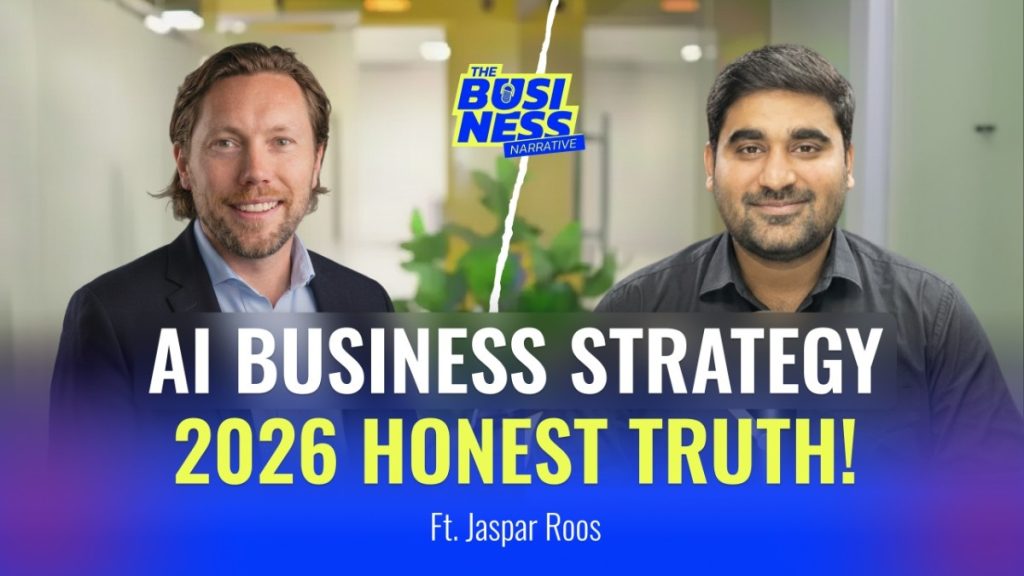
Want to hear the full story from an expert who has launched 50 companies? Go to YouTube and listen to the podcast episode here: Podcast
To navigate this landscape, we sat down with Jaspar Roos, a renowned innovation expert, former Chief Inspiration Officer at ABN AMRO, and a serial entrepreneur who has launched an astonishing 50 companies. Through his insights, cross-referenced with the latest 2025 and 2026 economic data, we are going to deconstruct exactly how you can build an AI-resilient business, dominate modern search engines, and leverage the one asset algorithms can never replace: the human premium.
What is an AI Business Strategy?
An AI business strategy is the deliberate integration of artificial intelligence tools to automate backend operations, analyze proprietary data, and accelerate workflows, while intentionally preserving authentic human interaction at the customer-facing frontend. It focuses on using AI to augment human capabilities rather than simply replacing human labor to cut costs.
The Brutal Reality of Startup Success Rates
When you hear that someone has launched 50 companies, the immediate assumption is that they possess a secret formula for guaranteed, uninterrupted financial success. Jaspar Roos is the first to shatter that illusion.
When asked about his success rate, his answer provides a sobering, vital lesson for any founder: “If you would get a success rate of 10% financially, of course, it’s already worth it… a success rate of 10% financially, of course, that is high.”
This is the reality of the entrepreneurial trenches. A 10 percent financial success rate is not a failure; it is the gold standard. But Jaspar introduces a secondary metric that is equally critical to your survival as a founder: the experiential success rate.
“Doing something that you like and that you found that little bucket in the market… I think I have like an 80% success rate of the initiatives I’ve launched,” he explains. True success is finding an underserved niche, building a solution you are proud of, and extracting systemic knowledge from the process. If you only focus on becoming a millionaire overnight, the inevitable setbacks will crush you.
Why 95% of Enterprise AI Pilots Fail
It isn’t just scrappy startups struggling to make AI work. The largest corporations on the planet are burning billions of dollars with shockingly little to show for it.
Despite 92 percent of companies planning to increase their AI investments over the next three years, recent studies deliver a terrifying wake-up call to the C-suite: 95 percent of enterprise AI pilots do not move the needle on profitability.
Why are the world’s most well-funded companies failing at AI?
- The Data Integrity Crisis: You cannot build a skyscraper on a swamp. Almost 98 percent of IT leaders cite data quality and integrity as the single biggest roadblock to AI adoption.
- Disconnected Implementation: Corporations are trying to bolt advanced AI agents onto brittle, decades-old legacy workflows. It is the equivalent of strapping a jet engine to a horse-drawn carriage.
- The Hype-Driven Mandate: Executives are purchasing AI tools because of board pressure, without clearly defining the profit-and-loss objectives. They are searching for problems to fit their new toys.
Jaspar’s philosophy cuts through this corporate bloat perfectly: “Make all the backend process automation AI… everything else that adds value, make that real.”
As an entrepreneur, your advantage over these massive enterprises is your agility. Do not implement AI just to say you have it. Use it to automate your invoices, clean your data, and score your leads. Free up your time so you can personally interact with your highest-value clients.
The Macro Layoff Bloodbath of 2025/2026
You cannot strategize for the future without understanding the harsh realities of the present labor market. In late 2025, the global workforce experienced a structural earthquake.
In October 2025 alone, American companies announced an astonishing 153,074 job cuts—the highest total for that month in over two decades. This was not a standard economic recession; this was a targeted, efficiency-driven purge orchestrated by the world’s largest companies:
- United Parcel Service (UPS): Slashed 48,000 jobs, driven by a strategic shift away from low-margin Amazon deliveries and the aggressive implementation of automation.
- Amazon: Eliminated between 14,000 and 30,000 corporate positions. CEO Andy Jassy explicitly cited the desire to run the company “like the world’s largest startup” by leveraging AI.
- Intel: Cut roughly 24,000 employees—15 percent of its global workforce—in a desperate bid to restructure and free up capital.
The Stock Market Disconnect
Here is the paradox that every entrepreneur must understand: Wall Street loved the bloodbath.
Following these massive layoff announcements, stock prices surged. The stock market inherently rewards short-term cost rationalization and aggressive AI posturing.
But as Jaspar warns, gravity eventually takes hold. “In the long run, of course, they will just make themselves irrelevant,” he notes. Firing your workforce to temporarily boost stock prices destroys institutional knowledge and customer experience. For the agile entrepreneur, these corporate layoffs represent a massive talent acquisition opportunity. The market is suddenly flooded with highly skilled professionals who have been alienated by corporate bureaucracy.
The Occupational Metamorphosis (Who Survives?)
The prevailing fear is that artificial intelligence will lead to total human obsolescence. But total job replacement is a myth. We are not facing an apocalypse; we are facing an occupational metamorphosis.
AI does not replace jobs; it replaces tasks. Let’s look at three highly debated roles.
1. Software Developers: From Coders to Cathedral Builders
With tools like GitHub Copilot generating code instantly, many assumed the software developer was dead. The data proves otherwise. The U.S. Bureau of Labor Statistics projects a massive 17.9 percent increase in software developer employment from 2023 to 2033.
Jaspar explains it beautifully: “A software developer, of course, is a builder of a cathedral… plain vanilla coding, that’s easy. But understanding true purpose… that’s very important.” AI lays the bricks; human developers are the architects.
2. Accountants: The Rise of the Algorithmic Auditor
Basic debit-and-credit bookkeeping is over. However, the accounting profession is evolving. We are seeing the rise of the “Algorithmic Auditor.” As companies deploy complex AI financial models, they need deeply experienced humans to audit those algorithms for ethical compliance, regulatory adherence, and hidden biases.
3. Call Centers: The Crisis of Human Connection
If there is one industry facing the deepest disruption, it is customer service. Reports indicate up to 45 percent of customer service roles could be automated by chatbots. But aggressive automation here is creating a massive consumer backlash.
When you call a corporate help desk, what do you immediately shout into the phone? If you are like Jaspar, you shout: “Human! Human! Cancellation!”
The statistics back this up:
- 79 percent of Americans strongly prefer interacting with a human over an AI agent.
- 84 percent of consumers believe human agents are more accurate than AI.
When a customer calls, they do not just want to be connected to a solution; they want to be collected. They want empathy and validation. In 2026, Tier-1 support is fully automated, but the human call center agent will evolve into a premium “experience orchestrator.”
The Human Premium (Why Books Beat Algorithms)
We are generating more digital content than at any point in human history. With AI tools, you can summarize a 400-page business book into three bullet points in two seconds. But in doing so, we are losing the cognitive friction required for true innovation.
When you rely entirely on ChatGPT to summarize your inputs, your outputs become fundamentally derivative. LLMs are trained on existing data; they regress to the mean.
How do you build a competitive advantage? You do things that do not scale. You engage in deep work.
Jaspar points out that the most successful founders on the planet read actual, long-form books. Reading exercises your imagination, builds empathy, and forces your brain to map complex, nonlinear relationships. Furthermore, authenticity has become the ultimate currency. In a world drowning in synthetic, AI-generated perfection, raw human vulnerability is the only thing that commands attention.
Engineering Digital Dominance in 2026 (The GEO Framework)
You have the strategy. You have the human touch. Now, how do you get customers to actually find you online in 2026?
Traditional Search Engine Optimization (SEO) is dead. Welcome to the era of Generative Engine Optimization (GEO). With Google deploying AI Overviews, up to 60 percent of traditional searches now yield zero clicks to external websites. To survive, you must engineer your digital assets so that the AI extracts and cites your content.
Here is the exhaustive blueprint for dominating search in 2026:
1. Shift from Keywords to Entity Optimization
Google no longer matches text strings; it maps relationships between concepts. If you are writing about “Startup Funding,” naturally incorporate related entities—”Venture Capital,” “Series A,” “Term Sheets,” “Burn Rate.” This establishes a “semantic distance” that proves deep topical authority.
2. Exploit Long-Tail and Zero-Volume Keywords
Fighting massive brands for short-tail keywords is a waste of capital. Target highly specific, conversational queries. Data shows that queries with eight words or more are 7 times more likely to trigger an AI Overview.
3. Build “Snippet Bait” with Semantic Chunking
Format your H2 and H3 headers as direct questions. Immediately follow the header with a concise, definitive 40-to-60 word answer. This is known as the Bottom Line Up Front (BLUF) method, and it is exactly what AI models extract to build Featured Snippets.
4. Weaponize E-E-A-T
Because generative AI can write infinite amounts of generic text, you must prove your humanity. Use first-person narratives (“In our testing”). Provide robust author bios. Delete the stock photos and use original screenshots and custom charts to provide undeniable “Proof of Work”.
The 2026 Entrepreneur’s Action Plan
The future of business belongs to those who view artificial intelligence not as a threat, but as a highly capable intern. Here is your actionable blueprint:
- Audit Your Workflows: Deploy backend AI agents to automate your invoicing, lead scoring, and scheduling.
- Protect the Frontend: Never let an AI handle a high-stakes, emotionally charged interaction with your clients. Reserve your human capital for relationship-building.
- Build a Proprietary Data Moat: Feed your AI with your company’s unique, historical data so it generates insights that your competitors cannot copy.
- Optimize for GEO: Restructure your website with semantic chunking and long-tail entity targeting.
- Cultivate Your Mind: Step away from the screen. Read deeply. Your ability to connect disparate ideas and demonstrate authentic empathy is the one premium the market will never be able to automate.
As Jaspar Roos advises his younger self: “Don’t be afraid to lose the stuff which is not yours… Nature gives, nature takes, and it’s going to be all right. Just relax, enjoy life.”
The AI revolution is here. Stop fighting the machines, and start utilizing them to build your cathedral.
Want to hear the full story? Go to YouTube and listen to the podcast episode here: Podcast
(Check out our TBNto see more Blogs)


![Why Your Mouth Is the Ultimate Gateway to High Performance [2026 Guide]](https://thebusinessnarrative.net/wp-content/uploads/2026/09/Podcast_Thumbnail_94-1.jpg)
