
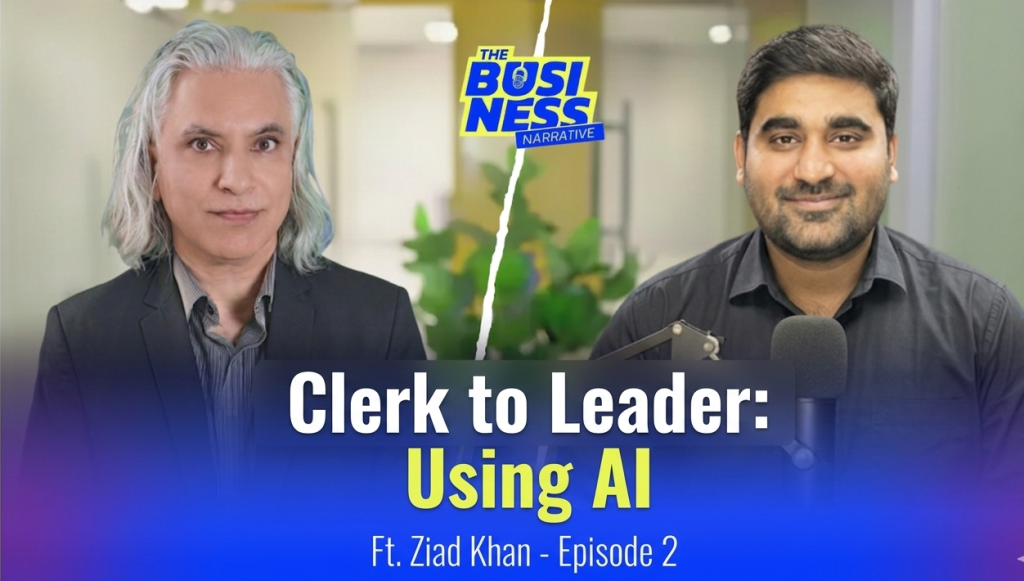
Thinking about launching a business? Most people wait for the “perfect” moment or a massive injection of capital before they take the first step. But according to Ziad Khan—Founder and Chairperson of Peace University—that’s exactly why most startups fail before they even begin.
In this episode of The Business Narrative, Ziad breaks down his experience mentoring over 1,200 startups. We dive deep into the “entrepreneurial brain,” the truth about AI taking your job, and why the “clerk mindset” is the silent killer of modern innovation.
Want to hear the full story? Go to YouTube and listen to the podcast episode here: Podcast
What is Entrepreneurship?
Entrepreneurship is the practice of identifying a problem and organizing a venture to address it, characterized by a fundamental shift in mindset—specifically the ability to think “outside the box” and a calculated willingness to take risks that others avoid. Unlike traditional business ownership, it is rooted in breaking societal “shackles” and limitations to create new value through innovation.
The Two Things That Separate Winners from Losers
Ziad has seen thousands of ideas cross his desk. The pattern for success isn’t intelligence—it’s execution and psychology. He identifies two main drivers:
- Thinking Outside the Box: Breaking the “shackles” of childhood—the “don’t do this, don’t touch that” mentality that limits adult creativity.
- Risk-Taking: The ability to step into the unknown when others seek the safety of a 9-to-5.
The “Zero Homework” Trap
90% of aspiring entrepreneurs do zero homework. Ziad notes that in the era of AI, research that used to take weeks now takes 10 minutes. If you aren’t willing to “burn the midnight oil” to validate your idea, you aren’t an entrepreneur—you’re a dreamer.
Will AI Take Your Job? (The Hard Truth)
There is a lot of fear surrounding Artificial Intelligence. Ziad’s take is punchy and direct: AI won’t take your job, but a person using AI will.
- Technology as a Support, Not a Savior: AI is a tool, like electricity or a spreadsheet. It requires a human mind to provide the “input” (the prompt) to generate value.
- Accuracy Warning: Don’t get carried away by the buzz. AI still lacks consistency and accuracy; it is a “powerful gun” that can shoot you in the foot if you don’t control the results.
How to Build a Culture of Trust (And Why You Should)
For CEOs struggling with retention and culture, Ziad offers a perspective rooted in faith and practical leadership: To be trusted, you must first trust.
Stop Managing Like a “Colonizer”
The “clerk mindset”—clocking in at 9:00 AM and waiting for instructions—is a remnant of a colonial past. High-growth startups need leaders, not clerks.
- Focus on Results: Ziad doesn’t track hours at Peace University. He tracks outcomes.
- The “Impossible” Mindset: A leader’s job is to turn “Impossible” into “I am possible.”
Bridging the Generation Gap: Millennials vs. Gen Z
The generation gap has shrunk from 30 years to just 10. As a leader, if you aren’t listening to the 12-year-olds or the Gen Zers in your office, you are becoming obsolete.
- Collaborative Economy: We have moved from a competitive economy to a collaborative one.
- Active Listening: The greatest quality of a leader is listening to understand, not listening to “tell.”
Actionable Takeaways for Entrepreneurs
- Do the Homework: Spend at least 30 minutes today using AI tools (Perplexity, ChatGPT, Gemini) to stress-test your business model.
- Audit Your Trust: Are you micro-managing? Try giving one team member full autonomy over a project this week.
- Be an “Outlier”: Read Outliers by Malcolm Gladwell. Understand that great things are done by “unusual” people who step outside their comfort zones.
Ready to stop being a “clerk” and start being a leader? Want to hear the full story? Go to YouTube and listen to the podcast episode here: Podcast
(Check out our TBNto see more Blogs)


![Why Your Mouth Is the Ultimate Gateway to High Performance [2026 Guide]](https://thebusinessnarrative.net/wp-content/uploads/2026/09/Podcast_Thumbnail_94-1.jpg)
