

You’ve got a brilliant software idea. You see a glaring inefficiency in a massive market, and you’re convinced that if you just build the tool, customers will come beating down your door.
It’s a classic founder trap.
We fall in love with the build. We use the latest no-code or AI tools, ship an MVP in a couple of months, and wait for the magic to happen. But the truth? The product is only 20% of the job. The other 80% is marketing, distribution, trust, and relentless persistence.
In a recent episode of The Business Narrative, we sat down with Tristan Tinn, a former NHS dentist turned tech entrepreneur and founder of HelpDental. Tristan walked us through how he spotted a massive operational gap in the UK dental booking market, why he chose to bootstrap instead of chasing venture capital, and the harsh realities of trying to change legacy user habits in a cautious industry.
Here is the exact playbook on how to escape the “build trap” and build a business that scales on your own terms.
What is a Healthcare SaaS Marketplace?
The Featured Snippet Target: A healthcare SaaS marketplace is a digital platform that connects medical or dental patients directly with healthcare providers by integrating with internal clinic software. Unlike static directories, it maps live provider availability and allows patients to instantly book appointments, eliminating manual inquiries, voicemails, and administrative back-and-forth.
The Invisible Market Gap: Empty Diaries vs. Desperate Patients
Every great business starts with a friction point that becomes too painful to ignore. For Tristan, that friction wasn’t discovered in a corporate tech incubator—it was discovered inside the dental surgery room.
“You’re in the surgery, you’ve got an hour of capacity, and your phone’s not ringing,” Tristan says. “But you know there’s people locally who need to be seen.”
This is the ultimate paradox of the UK dental sector:
- The Patient Side: People are calling practices, hitting voicemails, filling out endless contact forms, and struggling to find immediate care.
- The Provider Side: Dentists are sitting on expensive, unused capacity because of administrative bottlenecks.
The problem isn’t a lack of supply or a lack of demand. The problem is the missing operational layer.
While industries like hospitality (OpenTable) and travel (Booking.com) solved live-availability booking a decade ago, healthcare has lagged behind. Most dental clinics operate as fragmented islands. They have great internal tech for clinical work, but their front doors are still stuck in the era of manual phone calls.
The 80/20 Rule of Startup Success
If you are bootstrapping a business, your ultimate runway isn’t cash in the bank—it’s your motivation. And nothing kills motivation faster than launching a flawless product to absolute silence.
With today’s modern dev workflows, building a decent product is the easy part. The real battle is the distribution layer. How do you get cautious businesses and skeptical users to trust your workflow?
Tristan shares a harsh truth that every founder needs to accept before shipping code:
“The truth is, I think the product is maybe only 20% of the job. The other 80% is marketing, distribution, trust, and persistence. Product-market fit isn’t a fixed point that you just hit once. It’s constantly evolving and shifting.”
Why Your First Idea Will Probably Fail
When HelpDental first started, the instinct was to optimize the existing system—making email routing faster or helping clinics respond to contact forms quicker.
But optimizing a broken workflow doesn’t fix the underlying issue. The inbox and the phone call were the problem. The breakthrough happened when they bypassed the broken workflow entirely and introduced an agentic booking layer that inputs appointments directly into a practice management system.
The takeaway for entrepreneurs: Don’t just try to make a bad process slightly faster. Figure out how to delete the friction entirely.
Bootstrapping vs. Venture Capital: The Freedom Framework
When you build a startup, you have to choose your poison: Do you want to build a unicorn, or do you want to build a high-performing lifestyle business?
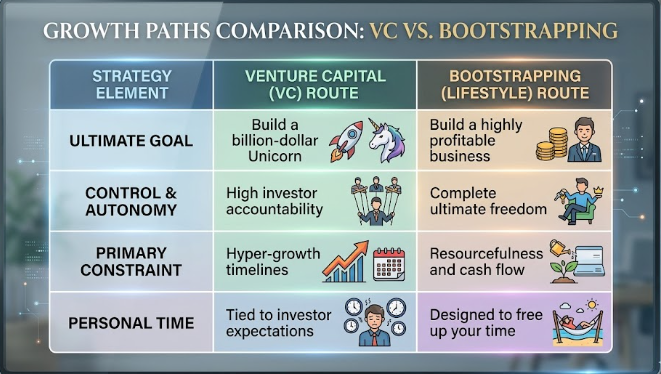
Tristan initially explored the VC route and drew significant investor interest. But he quickly walked away. Why? Because of the loss of control.
“You go from a self-employed entrepreneur with freedom to the shackles and expectations of someone else,” Tristan notes. “Is that not essentially akin to what employment is—the whole thing you’re trying to escape?”
If your goal is to build a business that frees up your time rather than restricting it, trading your equity for massive capital injection early on can turn your dream company into a high-pressure corporate job. By bootstrapping, you retain the agility to pivot based on market realities rather than investor board meetings.
Stop Waiting: Let Reality Correct Your Code
What is the single biggest piece of advice for the younger version of yourself? Start sooner and care less about whether the first venture is right or wrong.
The first iteration of your product won’t be right. Neither will the second. Tristan spent years thinking about his concepts before pulling the trigger. In hindsight, the winning play is always to ship the MVP in two months and let actual market usage correct your trajectory.
If you are building a B2B SaaS or a marketplace in an industry you currently work in, don’t rush to quit your day job. Clinical or corporate work keeps you close to the actual problem, keeps your insights honest, and directly funds your build.
Embrace the dual track, build your distribution engine before you think you’re ready, and remember that code means nothing without a customer.
Go to YouTube and listen to the full podcast episode here: PODCAST.
(Check out our TBN to see more Blogs)


![Why Your Mouth Is the Ultimate Gateway to High Performance [2026 Guide]](https://thebusinessnarrative.net/wp-content/uploads/2026/09/Podcast_Thumbnail_94-1.jpg)
