
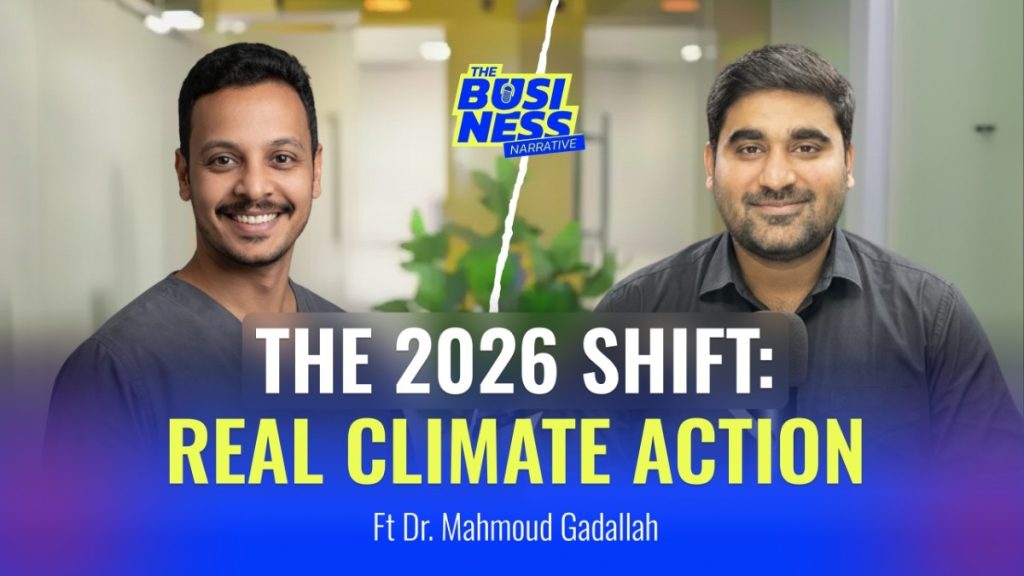
If we look closely at the modern business landscape as we move deeper into 2026, two massive, colliding crises are keeping entrepreneurs awake at night. The first is the abrupt and unforgiving death of the voluntary corporate climate pledge. The era where you could slap a “net-zero by 2050” badge on your website and instantly win favor with investors, consumers, and regulators is officially over. We have entered the era of extreme, verifiable climate implementation. Regulators are knocking on doors, and stakeholders are demanding receipts.
The second crisis is internal. It is the severe, compounding depletion of cognitive bandwidth among founders, medical professionals, and business leaders. You are being asked to completely overhaul your supply chains, navigate volatile energy markets, scale your revenue, and somehow maintain a semblance of personal well-being. The leaders tasked with executing these monumental, world-saving shifts are running on fumes, paralyzed by attention residue and reactive workflows.
How do we solve this? How do we build fiercely profitable, sustainable companies while actually having the time and mental clarity to enjoy the success?
In this comprehensive guide, we are tearing down the illusion of “soft ESG” and providing you with a rigorous, data-backed blueprint for transitioning your operations toward real-world climate implementation. We will explore the massive financial returns of commercial solar integration, using the municipal masterclass of Sharm El-Sheikh as our proving ground. More importantly, we will dissect the advanced time-management architectures utilized by elite, multi-hyphenate leaders. We are bringing in insights from Dr. Mahmoud Gadallah—a practicing neurosurgeon, CEO of the National Youth Front, and relentless social activist—to show you exactly how to engineer your daily schedule for maximum impact without sacrificing your sanity.
Want to hear the full story? Go to YouTube and listen to the podcast episode here: PODCAST.

What is Climate Implementation?
Climate implementation is the strategic execution of verifiable, science-based operational changes designed to permanently reduce a company’s greenhouse gas emissions. Unlike voluntary climate pledges, implementation demands the direct integration of decarbonization into financial models, physical infrastructure, and value chains, prioritizing measurable, real-world accountability over theoretical net-zero targets.
The Collapse of the Corporate Pledge
For the better part of a decade, corporate sustainability operated in a state of suspended animation. It was a declaration mode. Companies across the globe raced to announce the most ambitious climate pledges possible. Public relations teams celebrated these targets, and ESG (Environmental, Social, and Governance) funds poured trillions of dollars into organizations based entirely on what they promised to do decades in the future.
However, as the data from the past several years has been aggregated and analyzed, a deeply uncomfortable reality has emerged. The pledges did not work.
The Correlation Paradox
The 2025 ECGI Wallenberg Lecture, delivered by researchers at Imperial College London, highlighted a staggering statistical paradox that every entrepreneur must understand. As the volume of corporate net-zero pledges surged exponentially worldwide, aggregate global emissions continued to rise in tandem.
When researchers analyzed the data, they discovered a positive correlation of 0.32 between the proliferation of corporate climate commitments and the actual growth in emissions. This is the exact opposite of the intended outcome. It exposes a massive, systemic disconnect between what corporations declare in their annual reports and the real-world outcomes of their operational footprints.
When we dig into the granular analytics of the more than 3,000 global firms that have registered formal decarbonization targets, the failure in delivery becomes even more apparent. Currently, 72% of these firms are lagging significantly behind their pledged emission reduction trajectories. Even when evaluated on highly immediate, three-year short-term measures, 56% remain completely off track. On average, the actual rate of carbon reduction being achieved is 5.8 percentage points lower than what the corporate pledges mathematically demand.
Why is this happening? It comes down to a phenomenon known as the “selection effect.”
The companies that are naturally low emitters—such as software-as-a-service (SaaS) platforms, consulting firms, and digital media brands—are statistically far more likely to make loud, highly publicized decarbonization pledges because their path to net-zero is relatively frictionless. Conversely, the high-emitting firms in industrial manufacturing, heavy transport, and raw materials tend to remain silent. Consequently, even if every single low-emission firm achieves 100% of its target, the aggregate global impact is entirely overwhelmed by the rising output from the heavy emitters who never pledged in the first place.
The Illusion of “Soft ESG”
Another critical driver of this implementation gap is how executive boards have historically treated sustainability. For many, decarbonization demands from banks, investors, and supply chain partners were viewed simply as a cost of doing business—a box to be checked rather than a catalyst for genuine operational overhaul.
Instead of cutting actual emissions at the source, firms optimized their “soft ESG” profiles. They issued expansive policy statements, formed internal committees, and launched marketing campaigns that signaled deep environmental concern, all while leaving their core, carbon-intensive operations entirely unchanged. Furthermore, research indicates that a mere 9% of corporate pledges extend a comprehensive commitment to the year 2050, and only 12% actually commit to full, absolute decarbonization.
Many corporations also engage in a strategic accounting practice known as “backdating.” This involves a company selecting a historical year in which their emissions were at an absolute peak to serve as their baseline. By starting the measurement from an artificially inflated high point, any subsequent, marginal progress appears statistically much steeper and more impressive in sustainability reports than it actually is.
Visual Break: Suggestion to add an image or infographic here showing the gap between corporate climate pledges and actual emissions reductions.
The 2026 Reckoning: Litigation and Regulation
We are now operating in an environment where patience has evaporated. The market has shifted its focus from ambition to execution. If you are an entrepreneur looking to build a sustainable, resilient brand in 2026, you can no longer rely on pledges. You must build your strategy entirely around verifiable climate implementation.
This is not merely a moral imperative; it is a profound legal and financial necessity. The regulatory landscape has fractured and intensified. In the United States, states like California are aggressively enforcing the Climate Corporate Data Accountability Act (SB 253) and the Climate-Related Financial Risk Act (SB 261). These mandates force thousands of companies doing business in the state to provide assurance-ready reports on their carbon footprints, heavily emphasizing Scope 3 emissions—the complex, indirect emissions generated up and down a company’s entire value chain.
Simultaneously, the era of greenwashing is being met with severe legal retaliation. As of early 2025, over 2,700 ESG-related lawsuits had been filed globally, targeting companies for misleading sustainability claims. High-profile litigation against multinational consumer goods companies, major airlines, and financial institutions demonstrates that using unregulated marketing terms like “eco-friendly,” “natural,” or “carbon neutral” without rigorous, third-party substantiation now carries massive legal exposure.
Investors, too, have fundamentally changed their behavior. They are moving away from annual spot purchases of low-quality carbon offsets and demanding long-term offtake agreements backed by digital Monitoring, Reporting, and Verification (MRV) tools. They recognize that physical climate hazards—ranging from supply chain flooding to heat-driven productivity losses—are no longer distant scenarios to be debated, but immediate, recurring threats to cash flow and asset valuation.
Engineering Urban Decarbonization: The Sharm El-Sheikh Masterclass
To truly understand what effective climate implementation looks like in practice, we must look beyond corporate boardrooms and examine municipal infrastructure transformations. When an entire city successfully decarbonizes its operations, it provides a highly replicable, scalable blueprint that entrepreneurs can adapt for their own commercial real estate, supply chains, and manufacturing facilities.
During our conversation on The Business Narrative, Dr. Mahmoud Gadallah explicitly highlighted the urgent necessity of moving toward clean energy, citing the sweeping transformation of Sharm El-Sheikh in Egypt as a prime example of real-world accountability in action.
The Catalyst of COP27
Nestled dramatically between the Sinai Mountains and the Red Sea, Sharm El-Sheikh evolved rapidly from a remote, quiet fishing village into one of the premier global tourism destinations. However, this explosive economic expansion carried severe ecological consequences. The rapid construction of nearly 200 luxury hotels generated massive energy demands heavily reliant on fossil fuels. The resulting pollution from transport systems, poor waste management, and heavy coastal traffic placed intense stress on the region’s delicate coral reefs and water security.
The turning point occurred when Sharm El-Sheikh was selected to host the 2022 United Nations Climate Change Conference (COP27). This global spotlight served as the catalyst for the “Green Sharm El-Sheikh” initiative. Supported heavily by the United Nations Development Programme (UNDP), the Global Environment Facility, and the Egyptian government, the city executed a holistic, aggressive transformation aimed at proving that the tourism industry could lead a green revolution rather than simply contributing to the problem.
The Metrics of Municipal Implementation
What makes the Sharm El-Sheikh case study so vital for business leaders is that it bypassed the “pledge” phase and went straight into hard infrastructure deployment. They did not just talk about reducing emissions; they engineered the city to operate differently.
Table 1: Key Performance Indicators of Sharm El-Sheikh’s Climate Implementation
Translating Urban Success to Entrepreneurial Strategy
When we analyze the Sharm El-Sheikh transformation, several core principles emerge that every entrepreneur must integrate into their own climate implementation strategies.
First, they embraced the power of decentralized energy generation. The city did not wait for a single, massive utility-scale solar farm to be built in the desert. Instead, they integrated medium-sized solar power stations and small-scale photovoltaic (PV) systems directly into the existing built environment. They put solar panels on the international airport, the convention center, the local hospitals, public schools, and dozens of hotel rooftops. For a business leader, this proves that distributed energy resources (DER) are incredibly viable. You do not need to change the entire grid; you just need to change the power source for your specific warehouses, offices, and retail locations.
Second, the initiative successfully aligned sustainability with immediate profitability. The private sector adoption in Sharm El-Sheikh was largely driven by harsh economics. The hotels that invested in solar PV systems and energy-efficient LED upgrades experienced immediate, highly quantifiable reductions in their monthly electricity overhead. They turned a compliance requirement into a competitive margin advantage.
Finally, the project proved that true climate implementation must include community and social integration. The Green Sharm El-Sheikh initiative did not just install solar panels; it distributed 1.5 million reusable bags to eliminate single-use plastics and provided tailored sustainability training for over 300 individuals from the Indigenous Bedouin communities in the Nabq Protected Area. They built a localized, resilient workforce capable of sustaining the eco-tourism model for decades to come.
Visual Break: Suggestion to add an image here showing solar panels installed on commercial rooftops to illustrate decentralized energy generation.
The Hard ROI of Commercial Solar Integration
Dr. Gadallah noted that switching to solar energy is a “non-negotiable step for cities worldwide,” and that same absolute urgency applies to your business.
For the modern entrepreneur, transitioning your facilities to renewable energy—specifically commercial solar—is no longer an exercise in public relations or brand building. It is a rigorous, highly strategic financial hedge against severe operational vulnerability. If you are still relying entirely on grid power in 2026, you are leaving your balance sheet completely exposed to forces outside of your control.
The Crisis of Utility Rate Pressure
Across the globe, businesses are facing intense, compounding pressure from rising utility electricity rates. This is not a temporary spike; it is a structural shift driven by several converging factors. First, the grid is experiencing unprecedented congestion as populations grow and infrastructure ages. Second, the explosive, unanticipated growth of Artificial Intelligence and hyper-scale data centers is drawing massive amounts of power, straining grids and driving up the base cost of electricity for everyone else.
Furthermore, utilities are aggressively expanding time-of-use (TOU) pricing models and increasing peak demand charges. These rate changes typically take effect early in the fiscal year, meaning many businesses only realize the devastating impact on their operating margins and capital forecasting once the Q1 invoices arrive.
The Financial Mechanics of the Solar Hedge
Implementing a commercial solar system fundamentally alters this dynamic. By installing your own generation capacity, you are effectively locking in a fixed cost for your electricity over the 25-plus-year lifespan of the hardware. You are transitioning an unpredictable, escalating operational expense (OPEX) into a controlled, high-yield capital investment (CAPEX).
The economics of solar implementation have shifted dramatically in recent years. The technology has matured, and the financial returns are now routinely outperforming traditional, liquid investment vehicles.
Table 2: The Financial Mechanics of Commercial Solar in 2026
If you are waiting until mid-year to evaluate solar feasibility, you are making a strategic error. Late planning leads to rushed feasibility studies, limited equipment availability, and missed opportunities to align the project with crucial budget cycles. To dominate climate implementation, you must treat your energy infrastructure with the same aggressive optimization you apply to your sales funnels and product development.
The Mind of the Multi-Hyphenate Leader
Executing complex climate implementations, integrating renewable infrastructure, scaling a commercial enterprise, and maintaining a commitment to social impact is not for the faint of heart. It requires a level of executive function and operational discipline that far exceeds the norm.
To understand how to actually pull this off without burning out, we need to examine the psychological and operational frameworks of leaders who have mastered multiple, highly demanding disciplines simultaneously. Dr. Mahmoud Gadallah is the absolute embodiment of this multi-hyphenate archetype.
The Architecture of High Achievement
Consider Dr. Gadallah’s professional trajectory. He is an accomplished neurosurgeon who achieved his Ph.D. from Cranfield University, served as a Full Professor, and currently acts as the Dean of the Modern Academy for Computer Science and Management Technology in Cairo. His published academic research is staggering in its breadth, spanning complex medical procedures (such as predicting intraperitoneal adhesions) to highly advanced artificial intelligence applications, including federated learning models and autonomous robotic game-tree search algorithms.
Operating on the human brain—the body’s most critical and unforgiving organ—demands an uncompromising level of precision, focus, and emotional resilience. Yet, Dr. Gadallah did not limit his impact to the operating theater or the academic lecture hall.
Driven by a profound commitment to social equity, he serves as the CEO and Founder of the National Youth Front in Egypt. His activism is not a recent pivot; it began during his years in medical school, where he volunteered extensively with international organizations, including the UNFPA and the British Council, focusing on healthcare system improvement, women’s empowerment, and youth development programs.
During our podcast interview, when asked how one manages the crushing weight of such intense, disparate responsibilities, his answer cut straight through the noise: “Manage your time with things you love… focus on your skills and your mind. If you are a doctor or not, if you are in engineering or any specialist, manage your time.”
He is highlighting a fundamental truth: operating at an elite level across multiple domains does not rely on fleeting bursts of motivation or simple passion. It relies on rigorously engineered, highly defensive time-management frameworks.
Time Management Engineering: Defeating Cognitive Fatigue
For the modern entrepreneur, medical professional, or social activist, time is the ultimate constrained asset. You cannot buy more of it, and you cannot store it. Yet, the ambition to drive global climate implementation or scale a high-growth startup is frequently derailed by cognitive overload, administrative friction, and entirely reactive daily workflows.
Effective time management in 2026 is no longer about buying a nicer planner or writing a longer to-do list. It is about the algorithmic, defensive allocation of your cognitive bandwidth.
The Destructive Nature of “Half-Work”
The primary destroyer of entrepreneurial productivity is the toxic illusion of multitasking, commonly referred to as “half-work”.
Half-work occurs when a leader attempts to execute a high-level cognitive task—such as drafting a Scope 3 supply chain decarbonization strategy—while simultaneously monitoring Slack messages, checking email notifications, and glancing at social media. You believe you are doing three things at once; in reality, you are doing none of them well.
This constant division of attention generates a psychological phenomenon known as attention residue. When your brain switches from Task A (the climate strategy) to Task B (a quick email reply), a significant portion of your cognitive processing power remains stuck thinking about Task A. When you switch back, your brain takes time to re-engage. Over the course of a 10-hour workday, jumping back and forth between clinical duties, business strategy, and digital distractions compounds this residue. By 3:00 PM, you experience severe executive function fatigue, poor decision-making, and profound exhaustion, despite feeling like you have accomplished very little.
To combat attention residue, elite leaders must adopt monotasking. This means deploying 100% of your cognitive resources toward a single, clearly defined assignment until it is completed or until a pre-scheduled break occurs. You must eliminate the friction of context switching entirely.
Actionable Time Architectures for the Entrepreneur
To regain control of your schedule and drive meaningful impact, you must implement specific, structured methodologies to govern how you operate.
Table 3: Elite Time Management Architectures for High-Impact Professionals
Visual Break: Suggestion to add an image or graphic visually breaking down the Eisenhower Matrix and providing examples of tasks in each quadrant.
The Mechanics of Delegation and SOPs
Entrepreneurs and highly trained medical professionals frequently suffer from a severe operational bottleneck of their own creation: the absolute inability to delegate.
This reluctance usually stems from a perfectionist mindset or the deeply ingrained belief that training a subordinate to do the task will take more time than simply executing the task yourself. While true in the micro-moment, this mindset makes scaling impossible. You cannot run a hospital wing, lead a youth movement, and negotiate commercial solar contracts if you are also managing your own inbox.
To scale your impact, you must become obsessed with building Standard Operating Procedures (SOPs). An SOP is a documented, step-by-step process for executing a recurring task. Whether it is patient onboarding, client invoicing, or reviewing supplier carbon data, write the process down exactly as it must be done. By creating this replicable framework, you can hand off responsibilities to team members, junior staff, or virtual assistants without sacrificing quality control.
When you delegate, you must accept the reality of the “ramp-up period”. A newly delegated task will likely take the assignee 10% to 20% longer to complete than it would take you during the first few weeks. That is the cost of training. However, the long-term return on invested time (ROIT) is exponential, freeing you entirely to focus on high-leverage activities that actually move the needle on your overarching goals.
Shutdown Rituals: Protecting the Baseline
For the multi-hyphenate leader, the boundary between professional ambition and personal life frequently disintegrates. Your phone is always buzzing, the emails never stop, and the pressure to perform is constant. If left unchecked, this lack of boundaries leads inevitably to chronic, career-ending burnout.
To sustain elite performance over a timeline of decades rather than months, you must implement strict “Shutdown Rituals”.
A formal shutdown ritual involves a specific, non-negotiable sequence of actions at the exact end of your workday. This typically includes reviewing tomorrow’s calendar, closing out all open browser tabs, writing down any lingering thoughts on a physical notepad to clear your working memory, and physically shutting down your workstation.
This is not just about organization; it is a psychological trigger. It signals to your central nervous system that the workday has definitively concluded. It prevents the “Zeigarnik Effect”—the psychological tendency for the brain to intrusively remember uncompleted or interrupted tasks—from ruining your evening recovery and family time.
By prioritizing deep sleep, physical exercise, and absolute mental detachment from your work, you are actively protecting your most valuable, irreplaceable asset: your baseline cognitive health.
Cascading Accountability: Tying It All Together
The true synthesis of climate implementation and advanced time management culminates in your ability to drive systemic, lasting change throughout your entire organization. The grand strategies engineered in the C-suite are utterly useless if they fail to materialize on the front lines.
Recent analysis in the Business Action Guide to Climate Transition highlights a massive, structural vulnerability within modern corporations known as the “KPI Cascade Gap”. The data reveals that while 100% of surveyed corporate executives report having their personal compensation linked directly to sustainability targets, a mere 45% actually cascade these Key Performance Indicators (KPIs) down to individual business units, procurement teams, and mid-level managers.
This failure in delegation and accountability acts as a catastrophic brake on real-world implementation. If the people actually buying the materials and running the factories are not incentivized to reduce emissions, the emissions will not fall.
To bridge this gap and drive actual change, entrepreneurs must execute on three fronts:
- Translate Climate Ambition into Hard Business Language: Do not frame your climate action solely as a moral crusade or environmental stewardship. You must translate the strategy into the language of resilience, risk mitigation, and margin improvement. Show your CFO and your operations managers exactly how solar integration cuts overhead and how Scope 3 supply chain monitoring prevents regulatory fines.
- Force Cross-Functional Integration: Climate implementation cannot live in a siloed ESG department. It requires the aggressive coordination of Finance (to establish internal carbon pricing), Procurement (to mandate supplier decarbonization), Product Design (to engineer for circularity), and Operations (to upgrade facility infrastructure).
- Deploy Technology to Protect Bandwidth: Utilize advanced, agentic AI and carbon management software platforms to automate the brutal administrative work of data collection, verification, and scenario modeling. This “frugal AI” acts as an always-on assistant, filling capacity gaps and allowing your human experts to focus their protected time on high-level strategy and stakeholder engagement rather than manual data reconciliation.
The Final Verdict: Execution Over Everything
As we navigate the complexities of 2026, the mandate for entrepreneurs is crystal clear. We must reject the superficial. The era of the “soft ESG” corporate pledge, the hollow press release, and the greenwashed marketing campaign has collapsed. It has been replaced by an absolute, unforgiving demand for verifiable, infrastructural climate implementation.
The data leaves no room for debate: organizations that proactively invest in renewable infrastructure, such as the aggressive commercial solar integrations demonstrated in the Sharm El-Sheikh masterclass, are securing profound operational resilience, mitigating catastrophic risk, and locking in massive financial returns.
However, the execution of these complex, organization-wide transitions relies entirely on the cognitive discipline and bandwidth of the leaders steering them. You cannot save the world if you cannot manage your own inbox.
By adopting the rigorous time management architectures, ruthless delegation protocols, and focused monotasking strategies utilized by elite, multi-hyphenate professionals like Dr. Mahmoud Gadallah, you can reclaim the mental clarity required to lead.
Stop pledging. Start implementing. Protect your time, protect your focus, and build a business that actually alters the landscape.
Want to hear the full story? Go to YouTube and listen to the podcast episode here: PODCAST.
(Check out our TBNto see more Blogs)


![Why Your Mouth Is the Ultimate Gateway to High Performance [2026 Guide]](https://thebusinessnarrative.net/wp-content/uploads/2026/09/Podcast_Thumbnail_94-1.jpg)
