
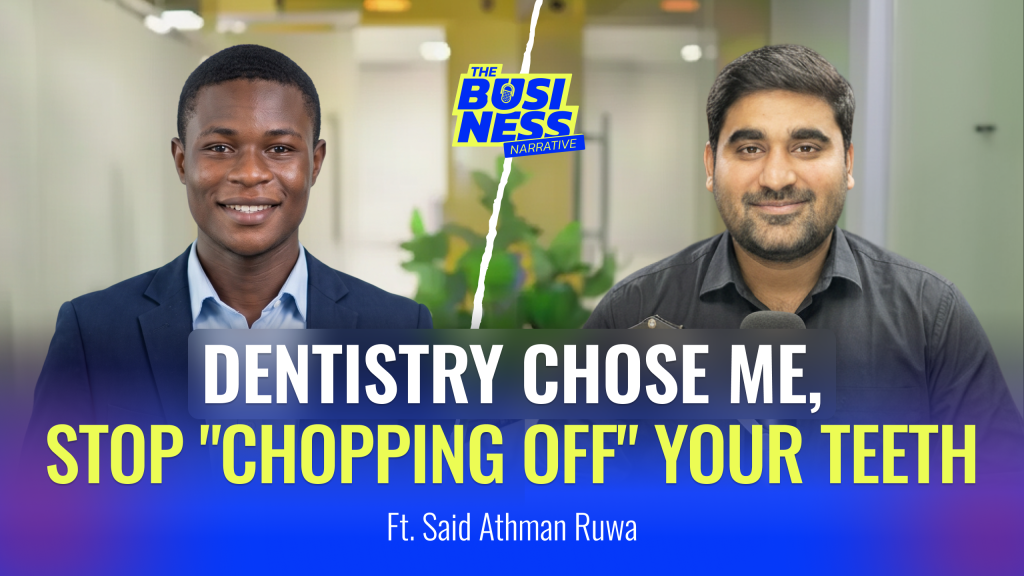
Most entrepreneurs launch businesses chasing a quick scaling model, seamless exits, or hands-off revenue streams. But what happens when your industry forces you to look face-to-face with a broken systemic framework?
In the latest episode of The Business Narrative, we sat down with Dr. Said Athman Ruwa, the mission-driven founder of MenoDAO and the Dr. Puppy Foundation. Practicing across borders in Sudan, Uganda, and Kenya, Dr. Said pulls back the curtain on the brutal realities of the dental profession—and why executing standard transactional services for a paycheck simply wasn’t enough.
Want to hear the full story? Go to YouTube and listen to the podcast episode here: Podcast
Moving From a Transactional Mindset to Systemic Value
Why do you show up to your venture every single day? Is it just to process a transaction, collect capital, and head home? Three years into his clinical dental practice, Dr. Said faced a massive alignment crisis.
The journey to becoming a specialized professional requires a massive runway. Dr. Said spent his entire youth—from grade one all the way through university graduation—preparing for his medical career. Yet, the traditional operational reality of standard dentistry felt incredibly small compared to that preparation. Show up, pull a tooth, get paid, go home.
If a business process fails to connect with a deeper purpose, it quickly degrades into a hollow routine. For true innovators, an industry shouldn’t just be an income stream; it must be an ecosystem where you map out long-term, scalable fixes for your market’s underlying gaps.
The Brutal 1:16 Tooth Metric: Market Awareness vs. Cheap Fixes
In any business landscape, if your target consumer lacks awareness regarding the long-term value of an asset, they will always default to the cheapest immediate option. This exact consumer psychology creates a massive health crisis in the East African dental sector.
In Kenya, a shocking industry metric reveals that for every 1 tooth saved, 16 teeth are extracted (or “chopped off”).
When consumers approach a problem with an entirely transactional mindset, economic constraints completely dictate their decision-making process. Dr. Said identifies three structural flaws in how patients view dental health assets:
- The Pocketbook Priority: Patients evaluate their current cash flow before selecting a treatment plan, prioritizing immediate affordability over optimal biological outcomes.
- The Preservation Discount: A patient will willingly pay a $4 fee to completely extract a healthy tooth rather than investing $20 in a preservation filling, simply because they view the short-term savings as a win.
- The Medical Inversion: While general medical patients will readily seek the absolute best long-term treatments for fractures or severe illnesses regardless of upfront pricing, dental patients frequently treat their teeth like written-off, disposable property.
The 8-Year-Old Patient: The Hard Catalyst for Strategic Change
Every major corporate pivot or non-profit launch is triggered by a painful, real-world catalyst. For Dr. Said, that definitive spark came in the form of an 8-year-old child and a complete lack of community education.
While volunteering at a public facility in Mombasa, a mother brought her young son into the clinic to address a minor cavity on a single tooth. The clinical solution was highly straightforward: a simple, non-invasive filling that would preserve the permanent tooth for the rest of the child’s life.
However, the mother aggressively demanded an extraction. Bound to a rigid community myth that physical removal is the only definitive cure for a toothache, she refused to listen to alternative options. Dr. Said spent over 30 minutes trying to educate, reason, and unpack the long-term biological consequences of her choice.
His educational efforts yielded nothing. Because an underage patient cannot legally consent to a treatment plan, he was forced to follow the mother’s uneducated mandate. He extracted a perfectly viable permanent tooth from an 8-year-old boy.
That emotional and professional failure became the precise foundational framework for the Dr. Puppy Foundation and MenoDAO. Dr. Said recognized that treating patients inside a clinic was merely a band-aid solution. To fix the market, he had to engineer an educational ecosystem that dismantles deeply rooted cultural myths before the patient ever steps foot inside an office.
The Entrepreneurial Playbook: Turning Failure Into Market Evolution
If you are currently navigating roadblocks within your own startup or career track, Dr. Said’s cross-border journey across Sudan, Uganda, and Kenya provides an actionable blueprint for execution:
1. Challenge Your Perspective Through Exposure
Operating within a singular market completely limits your strategic vision. Traveling and managing operations across multiple cultural landscapes challenges your internal biases and forces you to see how different populations experience unique structural problems.
2. Treat Failures as a Proximity Metric
Roadblocks are not a signal to quit operations. As Dr. Said states: “Failures are part of the journey. The more failures you know, the closer you’ve gotten to it.” Every operational breakdown brings you one step closer to isolating a bulletproof solution.
3. Build the Solution You Want to See
Stop waiting for someone else to correct a broken system. Locate the most painful, unaddressed systemic gap in your specific industry, step away from the crowd, and build the foundational change your market desperately requires.
Want to hear the full story? Go to YouTube and listen to the podcast episode here: Podcast
(Check out our TBNto see more Blogs)


![Why Your Mouth Is the Ultimate Gateway to High Performance [2026 Guide]](https://thebusinessnarrative.net/wp-content/uploads/2026/09/Podcast_Thumbnail_94-1.jpg)
