
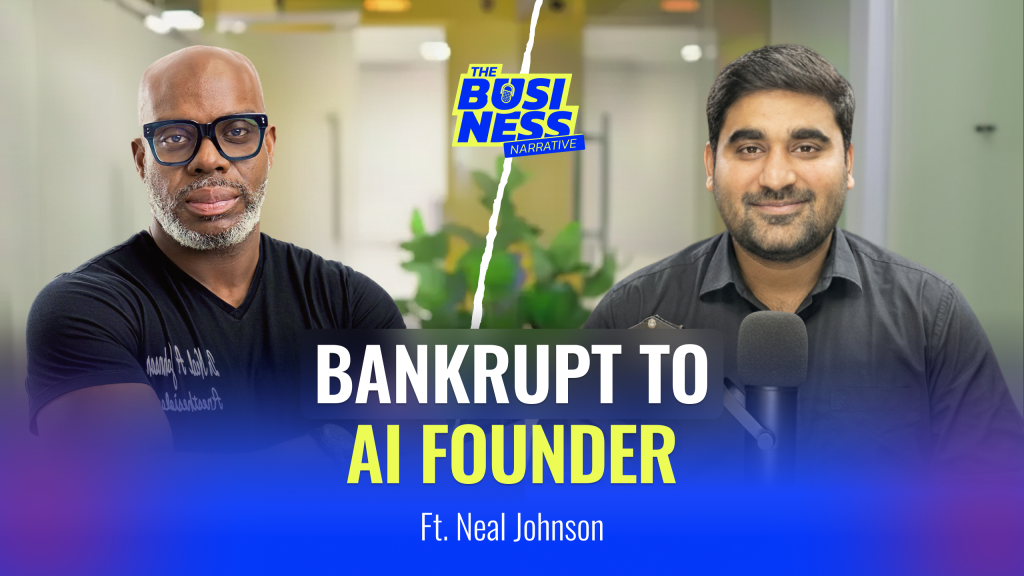
Want to hear the full story? Go to YouTube and listen to the podcast episode here: PODCAST
Most founders think you need millions in venture capital, a Silicon Valley pedigree, and a team of elite developers to launch a successful artificial intelligence platform.
They’re wrong.
In 2019, anesthesiologist Dr. Neal Johnson hit absolute rock bottom, facing a devastating personal bankruptcy. Fast-forward to today, and he is the founder and CEO of UIS Health LLC, running an innovative AI platform that standardizes clinical operations for multi-location dental practices.
How did he do it? He skipped the VC pitch decks, taught himself how to build software using AI tools, and leveraged the power of old-school bartering.
If you are waiting for a check to arrive before you build your business, Neal’s story is the reality check you need.
What is Dental Software Fragmentation?
Dental software fragmentation is the division of operational data across siloed, disconnected platforms used within dental practices—such as separate tools for imaging, billing, and patient engagement. This lack of integration prevents multi-location dental support organizations (DSOs) from extracting centralized, real-time insights to optimize their business operations efficiently.
Turning Rock Bottom into “Builder Mode”
When bankruptcy hit in 2019, Neal realized he had two options: wallow in self-pity or change his mindset and move. He chose what he calls “Builder Mode.”
“There was nobody coming to rescue me,” Neal says. “So I decided I was going to take this into my own hands.”
Instead of waiting for an opportunity, he forced himself to start networking aggressively. He wasn’t looking for handouts; he was looking to deliver value. Soon, word-of-mouth recommendations exploded, and he used that momentum to fund his true passion: solving massive engineering inefficiencies in healthcare.
The Anti-VC Playbook: Why Bootstrapping Wins in Healthcare Tech
In a tech ecosystem obsessed with raising capital, Neal explicitly chose to fully bootstrap his startup. Why? Because outside money often comes with strings that pull you away from your core mission.
- You Maintain Ultimate Control: Taking funding too early forces you to compromise your roadmap to satisfy investors. Bootstrapping lets you prove the concept on your terms.
- It Forces Financial Discipline: When you aren’t burning through a massive cash cushion, you learn how to prioritize features that actually yield a return on investment (ROI).
- You Negotiate from Strength Later: If you do decide to raise VC money down the road, having a profitable, validated product gives you massive leverage and prevents heavy equity dilution.
The numbers back this up. Roughly 77% of startup founders cite personal savings and early revenues as their primary funding source, while only a tiny 0.05% ever raise venture capital. Even better? Bootstrapped companies frequently hit profitability within 18 months, compared to the years of cash-burning typical of VC-backed peers.
The Hustler’s Secret Weapon: The Barter System
What do you do when you need software built but don’t have the cash to pay high-end developers? You trade value.
Neal utilized a modern barter system within his network. He figured out what other professionals needed and exchanged his own skillsets and services to get his software off the ground.
“Money doesn’t always have to be exchanged,” Neal notes. “As long as it’s ethical and legal, look at what you can offer upfront without expecting anything in return. Over time, that value comes back to you.”
By using early AI models to handle initial software prototyping and tinkering with the code himself, he was able to hand a baseline functional product to his developer friends, drastically reducing development costs.
Solving the DSO Data Nightmare: The Architecture of Unity
If you look at the dental tech landscape, it’s flooded with single-use tools. There is an AI tool for x-ray analysis, another for billing, and another for patient retention.
For a scaling Dental Support Organization (DSO) managing 20 or more locations, this creates an operational nightmare. The offices are frequently running entirely different Electronic Health Records (EHR) environments—like Dentrix at one site and Eaglesoft at another.
Neal’s platform doesn’t ask DSOs to rip out and replace their legacy infrastructure. Instead, his software sits on top of everything. It bridges the gap, pulling siloed data from various tools into a single, unified dashboard. Decision-makers can log into one ecosystem and immediately view a comprehensive, real-time snapshot of clinical and financial performance across the entire enterprise.
Work Hard vs. Work Smart: A Reality Check
Many younger founders think that “working smart” means looking for autom
ation shortcuts that eliminate the grind. Neal drops a heavy dose of Gen X reality on that myth.
- They are not mutually exclusive: You can and must work hard and work smart simultaneously.
- AI accelerates, it doesn’t replace: AI lets you iterate and build prototypes faster than ever before, but it won’t pull the 3:00 AM coding shifts for you.
- Execution trumps ideas: Every great creation starts in the human brain, but it remains a dream until you put in the grueling hours required to make it viable.
If you aren’t willing to lose sleep, sweat over data anomalies, and systematically dismantle operational problems, tech entrepreneurship isn’t for you.
Want to hear the full story? Go to YouTube and listen to the podcast episode here: PODCAST
(Check out our TBNto see more Blogs)


![Why Your Mouth Is the Ultimate Gateway to High Performance [2026 Guide]](https://thebusinessnarrative.net/wp-content/uploads/2026/09/Podcast_Thumbnail_94-1.jpg)
