

An actionable, value-dense breakdown for entrepreneurs looking to break into the biotechnology and pharmaceutical consulting space. Featuring raw insights from Dr. Bobby Singh on market gap analysis, capital survival strategies, global talent acquisition, and navigating the B2B life sciences landscape.
Biotech Entrepreneurship: How to Start and Scale
Want to hear the full story? Go to YouTube and listen to the podcast episode here: PODCAST.
Building a successful business in the life sciences sector isn’t a creative writing exercise; it’s a rigorous engineering discipline. If you’re looking to transition into biotech entrepreneurship, you cannot rely on guesswork. The market moves too fast, the regulatory frameworks are complex, and the cost of mistakes is devastating.
In this deep dive, we sit down with Dr. Bobby Singh, Founder of CQ Advisory, to unpack how he successfully transitioned from a practicing physician into a powerhouse biotech consultant. Whether you are seeking to identify untapped market gaps, survive a brutal first year without primary clients, or expand across global borders, this guide serves as your executive blueprint.
What is Biotech Entrepreneurship?
Biotech entrepreneurship is the process of founding, funding, and scaling an organization that leverages biological innovations, pharmaceuticals, or medical technologies to solve critical healthcare challenges. It bridges advanced clinical research with strategic commercial models to bring life-saving therapies, medical devices, or specialized advisory services to a global market.
1. Spotting the Market Gap: The “One-Stop” Solution
Before you launch a startup or a niche consulting firm, you must establish a deep baseline of industry knowledge. Dr. Singh gained his grounding by working within massive pharmaceutical infrastructure giants—including Sanofi, GlaxoSmithKline (GSK), and Merck across the APAC region.
Through his tenure, he identified a critical structural flaw: extreme operational fragmentation.
- Regulatory affairs teams worked in complete isolation.
- Market access teams operated in a separate silo.
- Sponsors and clients were forced to manage multiple disparate entities to launch a single product.
The strategic solution? Consolidate these fragmented units under one roof to simplify operations for global clients. In biotech entrepreneurship, value is created by removing friction for your clients.
2. The First 12 Months: Navigating the Capital Valley of Death
Let’s look at the unvarnished reality: the first year of building a biotech business can be financially dry and isolating. Dr. Singh operated for a full 12 months without major anchoring clients. To survive this phase, you must deploy a two-pronged strategy:
- Maintain a Financial Buffer: Never launch without liquid runway or a supplementary income stream. Dr. Singh balanced his initial build by maintaining a part-time clinical practice to cover overhead costs.
- Prioritize Physical Rapports: While digital communication platforms keep overhead low, complex B2B deals require handshakes. You must meet partners face-to-face to gauge expectations and establish absolute trust.
Eventually, momentum shifts. By leveraging relationships with former colleagues and turning initial wins into referral engines, your client base will grow naturally through high-value word of mouth.
3. The B2B Marketing Matrix vs. Traditional Funnels
If you are building a product or service in the biotech domain, forget traditional consumer marketing funnels. The standard B2C framework does not apply here. Your core offerings—such as running clinical research programs, navigating regulatory pathways, or leading medical affairs training—are highly specialized.
How do you market to businesses when promotional boundaries are strictly monitored?
- Deploy Unbranded Disease Awareness Campaigns: Partner directly with corporate sponsors to create educational forums detailing the disease landscape, treatment methodologies, and preventative options.
- Simplify the Communication Syntax: Even when dealing with complex scientific spaces (like shingles or herpes zoster vaccines), your primary message must be stripped of unnecessary jargon. Clear, direct communication wins the trust of enterprise stakeholders.
4. Avoiding the Legacy Trap: Innovation Over Rigidity
Why did historical giants like Yahoo and Nokia lose dominant market control? They resisted evolution. The moment you become rigid with your operational models or client offerings, you invite obsolescence.
To protect your biotech business from this trap, you must operate as an agile, extended arm of your client’s enterprise. Your positioning shouldn’t just be about dollars and cents; it must focus on building long-term strategic value where your client’s success directly mirrors your own.
5. Top Global Markets for Biotech Expansion
If you want to maximize your startup’s evaluation and secure institutional funding (from Seed stages through Series A, B, and C), geography matters. Look toward regions backed by powerful government incentives and massive talent pools:
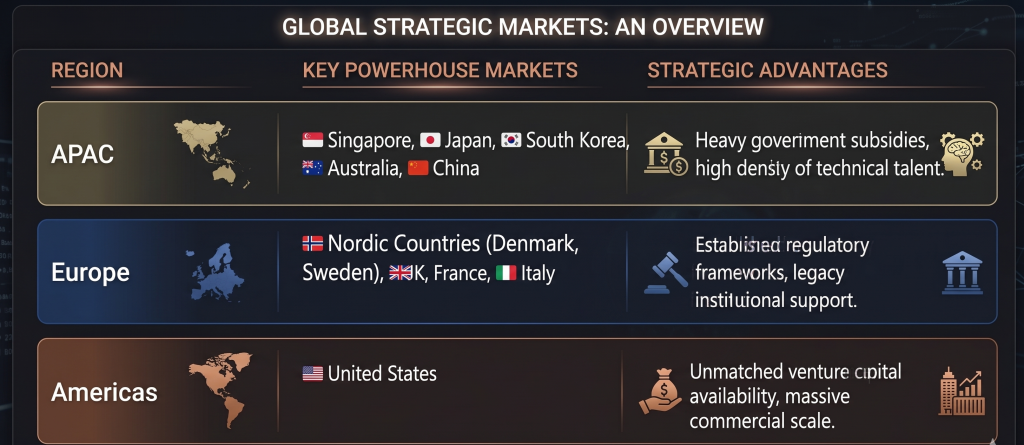
Note: If you are building a purely advisory or consulting organization, geographic barriers disappear. You can establish your base anywhere, provided you are willing to manage asynchronous global time zones across the US and Europe.
6. Retaining Top-Tier Technical Talent
In a knowledge-based economy, your business is only as strong as your subject matter experts. Replacing an elite consultant is a tedious, expensive process. Retaining them requires a shift in management style:
- Abandon the “Mr. Know-It-All” Mindset: You are employing specialists who often understand their precise domains better than you do. Listen to their guidance.
- Acknowledge and Reward Input: Recognize their project contributions early and often.
- Accept Natural Attrition: The era of a 20-year employee is over. Design your operational infrastructure around the reality that experts join for seasons, not lifetimes. Look for experienced professionals who can hit the ground running without requiring basic training.
The Future Frontier: Will AI Replace Humans in Biotech?
Are robots coming for your business? No. While AI has streamlined data processing, clinical tracking, and operational automation, it remains limited by a critical boundary: ethics.
The future of biotech relies on strict ethical guardrails and human decision-making to ensure that powerful technological innovations are never abused. AI is an accelerator for human capability, not a replacement for human judgment.
Dr. Singh’s Advice to His Younger Self:
“Start sooner. Don’t let hesitation or the comfort of working for legacy pharmaceutical companies delay your entrepreneurial launch. Spend the time needed to understand the underlying business units, but step out into the market the moment your foundational knowledge is secure.”
Want to hear the full story? Go to YouTube and listen to the podcast episode here: PODCAST.


![Why Your Mouth Is the Ultimate Gateway to High Performance [2026 Guide]](https://thebusinessnarrative.net/wp-content/uploads/2026/09/Podcast_Thumbnail_94-1.jpg)
