

Most custom manufacturers fail because they blindly copy Toyota’s high-volume Lean playbook. Applying High-Mix Low-Volume (HMLV) “Job Shop Lean” principles allows specialized operations to slash lead times, eliminate waste, and scale profitably without sacrificing product customization.
What is High-Mix Low-Volume (HMLV) Manufacturing?
High-Mix Low-Volume (HMLV) manufacturing is a production environment where a facility produces a high variety of customized products in small quantities. Unlike high-volume assembly lines, HMLV operations require flexible workflows, specialized job shop routing, and tailored Lean methodologies to shorten customer lead times and minimize Work-In-Process (WIP) inventory.
Why Toyota-Style Lean Fails Custom Job Shops
Standard Lean thinking was built for automotive assembly lines—making thousands of identical parts daily. Applying those exact rules to a $20M custom aerospace or medical machine shop creates chaos.
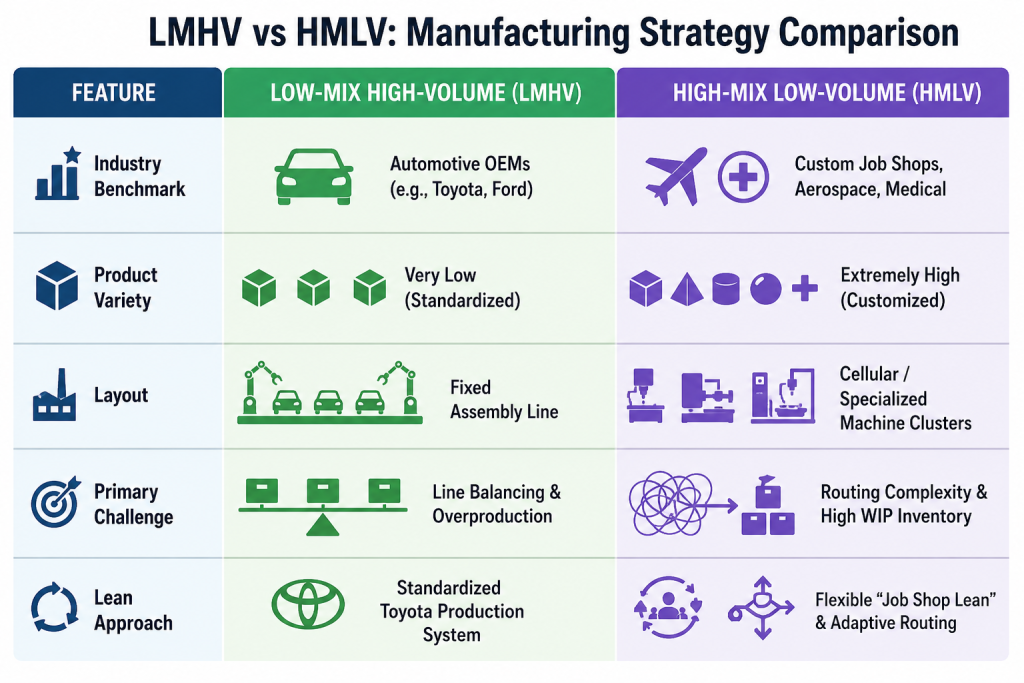
3 Strategic Rules to Scale an HMLV Business
1. Master Little’s Law to Slash Lead Times
In queuing theory, Little’s Law proves that long order completion times directly flood your shop floor with excess Work-In-Process (WIP).
- Shrink average flow time: Winning contracts isn’t just about price; it’s about speed. If your shop delivers in $X$ days while competitors take $2X$ days, you win the deal.
- Convert WIP to cash: Less clutter on the floor directly boosts liquidity and operational cash flow.
[Visual Suggestion: Diagram of Little’s Law showing Lead Time reduction lowering WIP]
2. Focus on Throughput Over Theoretical Efficiency
As Eliyahu Goldratt outlined in The Goal, real business growth requires three core metrics:
- Maximize Throughput: Sell orders faster to generate revenue.
- Reduce Inventory: Stop locking up capital in unprocessed raw materials.
- Minimize Operating Expense: Eliminate genuine waste without crippling capability.
3. Replace 100-Year-Old Process Charts with SmartCharts
Traditional process mapping is outdated. By combining shop-floor worker insights with low-cost video analytics and digital time studies, SmartCharts bridge the gap between engineering theory and shop-floor execution—reducing Kaizen event times from five days down to two.
The Hard Reality for Academic Founders and Startup CEOs
- Track Record Beats Research: Academic papers don’t convince investors or clients—proven shop-floor execution does. Secure industry sponsors before launching.
- Accept Harsh Criticism: Welcome ruthless feedback from operators. Ditch the ego to refine your product for real-world application.
- Do No Harm: True leadership builds efficiency without treating employees as disposable headcounts. Optimize workflows to reallocate human talent, not destroy it.
Want to hear the full story? Go to YouTube and listen to the podcast episode here: PODCAST
(Check out our TBN to see more Blogs)


![Why Your Mouth Is the Ultimate Gateway to High Performance [2026 Guide]](https://thebusinessnarrative.net/wp-content/uploads/2026/09/Podcast_Thumbnail_94-1.jpg)
