
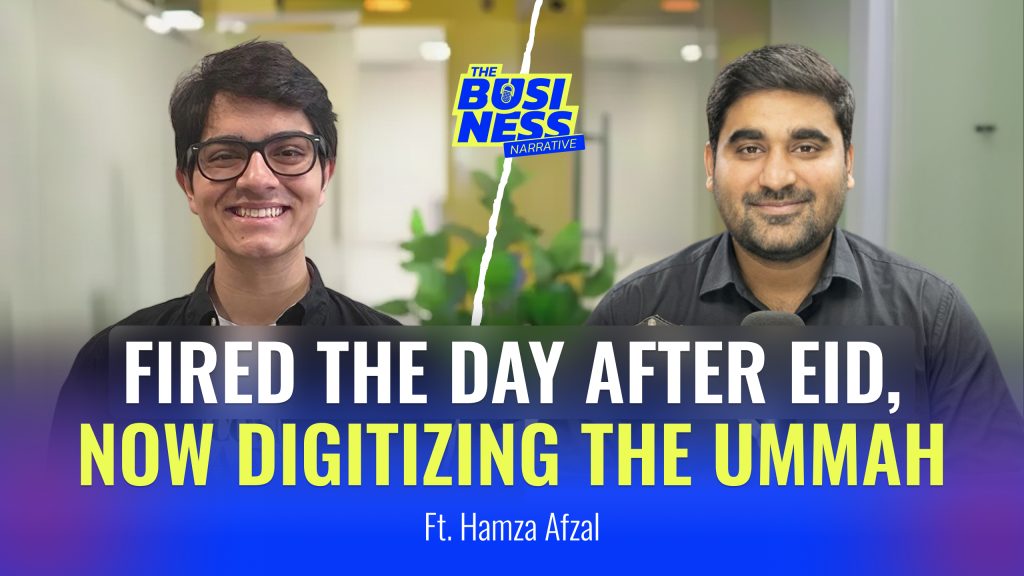
Explore how Muslim tech startups are building the Digital Ummah. Learn the faith-driven entrepreneurship playbook to scale in the $10.5T Halal economy.
Want to hear the full story? Go to YouTube and listen to the podcast episode here: Podcast.
If you’re building a Muslim tech startup today, you know the struggle. Scaling a global platform while refusing to compromise your faith is the ultimate operational bottleneck. The digital world demands viral growth, but standard Silicon Valley playbooks often clash directly with Islamic values. In our deep dive into faith-driven entrepreneurship, we found that solving this exact friction is your ticket to dominating the multi-trillion-dollar Halal economy. Here is your definitive blueprint. Let’s break down how Hamza Afzal turned a sudden layoff into “Ummah”—a masterclass in faith-aligned SaaS engineering.
What is the Digital Ummah?
The Digital Ummah is a transnational, decentralized online ecosystem connecting the global Muslim population through shared digital infrastructure. It encompasses Shariah-compliant digital economies, ethical software platforms, and online community networks that facilitate Islamic education, Halal commerce, digital Zakat distribution, and global civic solidarity.
How Did a Post-Eid Firing Launch a Global Tech Platform?
Imagine getting fired the day after Eid. For most, it’s a crisis. But for Hamza Afzal, it was the catalyst he needed. In the cutthroat world of secular venture capital, a setback like this usually forces a rapid, profit-at-all-costs pivot. But as faith-driven founders, we operate in a “moral economy” aligned with the Maqasid al-Shariah (the higher objectives of Islamic law).
Afzal took his years of product management experience and aimed it at a glaring infrastructure gap: our fragmented Muslim communities. Before the Ummah app, you had to juggle a disjointed mess of prayer apps, random ticketing sites, and endless WhatsApp groups. It was an operational nightmare for local mosques running on tight budgets.
How Do You Build a Roadmap on 6,236 Ayats?
Here is the ultimate differentiator. Instead of slapping an “Islamic” skin on a generic Silicon Valley template, Afzal pulled his product roadmap directly from the 6,236 Ayats of the Quran. He ensured that ethical frameworks weren’t just an afterthought—they became the core logic of the code.
We consistently see that the prophetic model of business prioritizes stakeholder welfare and long-term community wins over quick cash grabs. The Ummah app brings this to life by handing mosque leaders institutional-grade management tools. Even better? They locked in an industry-low platform fee of just 3%, keeping crucial funds right where they belong—in the local ecosystem.
What is the Market Size for Muslim Tech Startups?
Let’s look at the data, because the macroeconomic tailwinds pushing faith-driven tech forward are massive. If you’re a founder or an investor, you are staring at one of the highest-growth opportunities of the decade.
- The Halal Economy: Backed by aggressive government initiatives across the GCC and Southeast Asia, the halal economy is tracking to hit an incredible $10.5 trillion by 2030.
- Islamic Fintech: The global Islamic fintech sector isn’t just growing; it’s accelerating at an 11.5% annual rate, projected to reach $341 billion by 2029.
- The Creator Economy: Goldman Sachs forecasts the global creator economy will surge to $480 billion by 2027.
If you can engineer a startup that seamlessly blends ethical, Shariah-compliant community tools with creator monetization, you are perfectly positioned to capture serious institutional capital.
Why is “Online-to-Offline” Engagement Your Best Moat?
Historically, Islamic authority lived in physical mosques. Today, the Cyber Islamic Environment has scattered that authority, often rewarding algorithmic virality over genuine scholarly depth.
In our testing of digital communities, we’ve seen firsthand how algorithmic feeds create spiritual shallowing and systemic exclusion. The Ummah platform beats this by rewriting the user journey entirely.
Instead of trapping you in an endless scroll, the app champions an “Online to Offline” (O2O) philosophy. By acting as a high-powered event discovery engine, Ummah uses digital infrastructure to do what matters most: drive real-world, physical congregation. It proves that ethical tech can actively repair our fragmented social fabric.
People Also Ask (PAA)
How can Muslim tech startups secure funding?
You can secure funding by targeting Shariah-compliant venture capital firms, joining Islamic fintech accelerators, and proving your model aligns with ethical business principles while maintaining highly scalable unit economics.
What makes an app Shariah-compliant?
A Shariah-compliant app actively avoids promoting haram (forbidden) industries, strictly protects user data privacy, operates on transparent pricing models to prevent excessive uncertainty (gharar), and exclusively uses interest-free payment gateways.
Want to hear the full story? Go to YouTube and listen to the podcast episode here: Podcast
(Check out our TBNto see more Blogs)


![Why Your Mouth Is the Ultimate Gateway to High Performance [2026 Guide]](https://thebusinessnarrative.net/wp-content/uploads/2026/09/Podcast_Thumbnail_94-1.jpg)
