
Will artificial intelligence take your clinical job, or will it turn you into a far more efficient practitioner? While apocalyptic headlines claim AI algorithms will render healthcare professionals obsolete, the reality on the ground is radically different. Integrating technology into real-world workflows isn’t about replacing human expertise, it’s about removing operational friction so clinicians can focus on high-value patient care.
What is AI in Healthcare and Dentistry?
AI in healthcare refers to machine learning algorithms and robotic tools designed to assist clinicians in diagnostics, administrative workflows, and operational tasks. Rather than operating autonomously, healthcare AI acts as a clinical co-pilot, analyzing patient radiographs, organizing components, and streamlining equipment sterilization with high precision under human supervision.
3 Entrepreneurial Rules for Building Healthcare Tech (That Actually Works)
Dr. Tarek Sharkas, dentist, Western University professor, Partner at Dentalcorp, and founder of healthcare robotics innovations like the MAX81 sterilization bay robot—joined The Business Narrative to share how technology is actually evolving in clinical settings. Here is what every founder and practitioner needs to know:
1. Build for Practical Workflows, Not Flashy Hype
The global dental AI market is projected to reach $3.2 billion by 2034, but shiny tech fails fast if it doesn’t solve a daily headache. Dr. Sharkas didn’t set out to build complex clinic hardware overnight; his MAX81 robot started as a 2020 COVID lockdown hobby to entertain his kids. It evolved into serious clinic hardware only when he recognized a massive friction point in instrument sterilization. Similarly, his CBI tray solved a personal pain point with complex implant component organization.
- Focus on daily friction: Solve the messy, repetitive tasks that drain your clinical day.
- Validate in real-world settings: Tech that looks impressive in a lab often breaks down in a fast-paced clinic. Test it in your own operational environment first.
2. Separate Your Ego from the Machine
Entrepreneurship forces you into survival mode, where unpredictable variables test your resilience every few days. The secret to surviving product development is detaching your personal identity from your innovation.
- Demand brutal peer feedback: Ask your closest colleagues for honest, unvarnished critiques of your prototype.
- Filter out noise, accept actionable critiques: While diagnostic AI tools can spot dental caries with over 90% accuracy, they still struggle with complex cases. Understanding where your technology fails allows you to pivot and optimize quickly.
3. Treat AI as a Co-Pilot, Not a Replacement
Can a robot empathize with a nervous patient or execute complex clinical judgment during an unexpected complication? Absolutely not. While AI excels at pattern recognition and administrative tasks, human creativity and licensed clinical judgment remain irreplaceable.
- Double-check the algorithm: Never rely on AI blindly—use it to catch what human eyes might miss, then verify with raw data.
- Master the technical fundamentals: Even in an era of automated code generators like ChatGPT or Claude, Dr. Sharkas notes that understanding core fundamentals (like coding basics) is critical for debugging software and leading engineering teams.
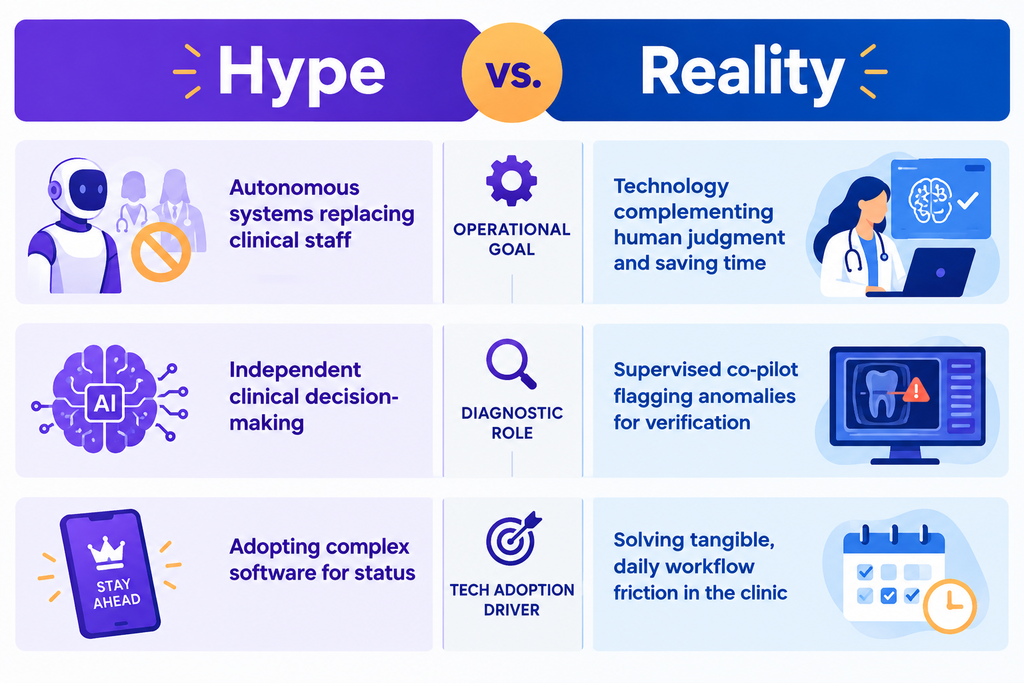
AI won’t replace dentists or healthcare professionals, but practitioners who leverage AI tools will inevitably outpace those who don’t. By focusing on real clinical pain points, seeking continuous feedback, and keeping human judgment at the center, healthcare founders can build tools that truly transform patient care.
Want to hear the full story? Go to YouTube and listen to the podcast episode here: PODCAST.


![Why Your Mouth Is the Ultimate Gateway to High Performance [2026 Guide]](https://thebusinessnarrative.net/wp-content/uploads/2026/09/Podcast_Thumbnail_94-1.jpg)
