
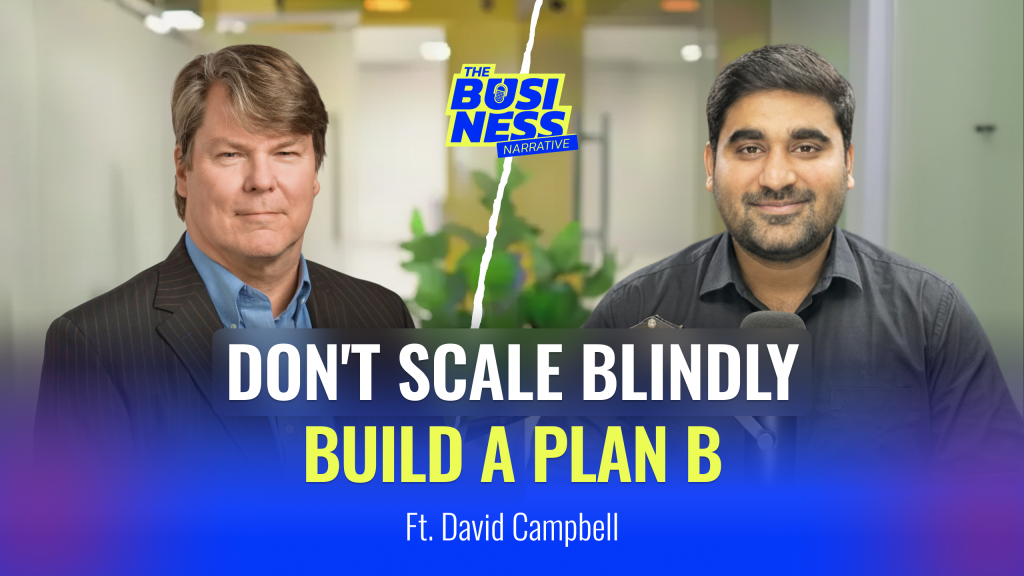
Most entrepreneurs try to force their initial business plan into the market until their bank accounts run dry. But what if the secret to strategic growth isn’t just moving faster, but knowing exactly when to pivot?
If you just start adding expenses hoping sales will eventually catch up, you are going to find yourself completely upside down. We sat down with strategic growth leader David Campbell to unpack the brutal reality of sustainable growth, the danger of desperate decisions, and why your customer’s buying choices are almost entirely emotional.
Want to hear the full story? Go to YouTube and listen to the podcast episode here: PODCAST
What is a Plan B in Business?
A business Plan B is a strategic financial and operational guardrail designed to protect a company’s cash flow when initial market assumptions fail. It serves as a pre-planned pivot mechanism that allows entrepreneurs to change course without burning through emergency capital, ensuring the business survives unpredictable shifts.
The Most Brutal Lesson in Scaling: Stop Forcing It
We’ve all seen it: a founder gets a cash injection, scales their marketing, hires a massive team, and then realizes the market doesn’t actually want what they are selling.
The real world doesn’t care about your initial business plan. If you keep forcing your assumptions into a marketplace that isn’t responding, all you are doing is burning capital. You have to establish guardrails. Ensure your cash flow is keeping up with your expense burn. If it isn’t, you need the flexibility to pivot before you have to go crawling back to investors who are already weary of your promises.
Actionable Growth Guardrails:
- Audit Your Cash Flow: Never scale expenses based on projected best-case scenarios.
- Do the Upfront Homework: Do you actually understand your barrier to entry and competitive landscape?
- Distinguish Bold from Desperate: Bold decisions are backed by data and patience. Desperate decisions happen when you realize you didn’t look around the corner.
The Science of Emotional Connection
Why do people spend thousands of dollars on Taylor Swift tickets when they could stream the music in high definition at home for free? Why do people buy a Rolex when a basic watch tells the exact same time?
Because practically no one buys based solely on logic.
According to Harvard Business School professor Gerald Zaltman, 95% of purchasing decisions are made in the subconscious mind and are driven entirely by emotion.
People buy a Rolex for the status it signals and how it makes them feel. People will overlook the fact that a famous “2-minute noodle” brand actually takes longer to cook, or that their expensive Apple device might have battery issues. Why? Because when a buyer is emotionally invested in a brand, they are willing to overlook logical flaws and premium price tags.
If your marketing only lists the features and benefits of your product, you are losing. You need to talk to your customers about themselves first. How does your product make them feel?
Why Massive Influencer Campaigns Fail
In 2026, we are still watching brands dump massive budgets into influencers with huge followings, only to generate zero sales.
Why does this happen? Because there is a total disconnect between the influencer’s audience and the brand’s emotional core.
Think about it: If you pay Taylor Swift to promote a senior housing facility, you are going to get millions of impressions—and absolutely zero leases. The audience looking for senior housing feels no connection to a pop star. Stop wasting money trying to reach everybody.
As the famous marketing adage goes, “I know that 50% of my advertising is wasted. I just don’t know which 50%.” Today, you don’t have that excuse. You have the tools to be hyper-targeted.
How to Target Your Ideal Customer:
- Identify the Emotional Hook: What is the psychological reason they need your product?
- Map the Customer Journey: Where are they hanging out when they are most likely to experience the pain point you solve?
- Align the Messenger: Ensure whoever is delivering your message actually resonates with your buyer’s lifestyle.
Final Takeaway: Don’t Jump Without a Parachute
Patience is a massive competitive advantage. Continue to refine your message. Reach out to your target audience to find out exactly what you are doing right and what you are getting wrong. Pivot when you have to, and never assume that your initial game plan is bulletproof.
As David Campbell puts it: “Don’t jump off the cliff until you know where your parachute is.”
Want to hear the full story? Go to YouTube and listen to the podcast episode here: PODCAST
(Check out our TBNto see more Blogs)


![Why Your Mouth Is the Ultimate Gateway to High Performance [2026 Guide]](https://thebusinessnarrative.net/wp-content/uploads/2026/09/Podcast_Thumbnail_94-1.jpg)
