
There is no such thing as a secure job anymore. If you are sitting in a corporate office right now, relying on a monthly salary and assuming your career trajectory is mapped out, you are taking a massive risk.
Transitioning from a massive corporate machine to building your own business is brutal. You go from having dedicated HR, finance, and logistics departments to packing your own shipping boxes at the local post office. But if you can survive the pivot, the upside is limitless.
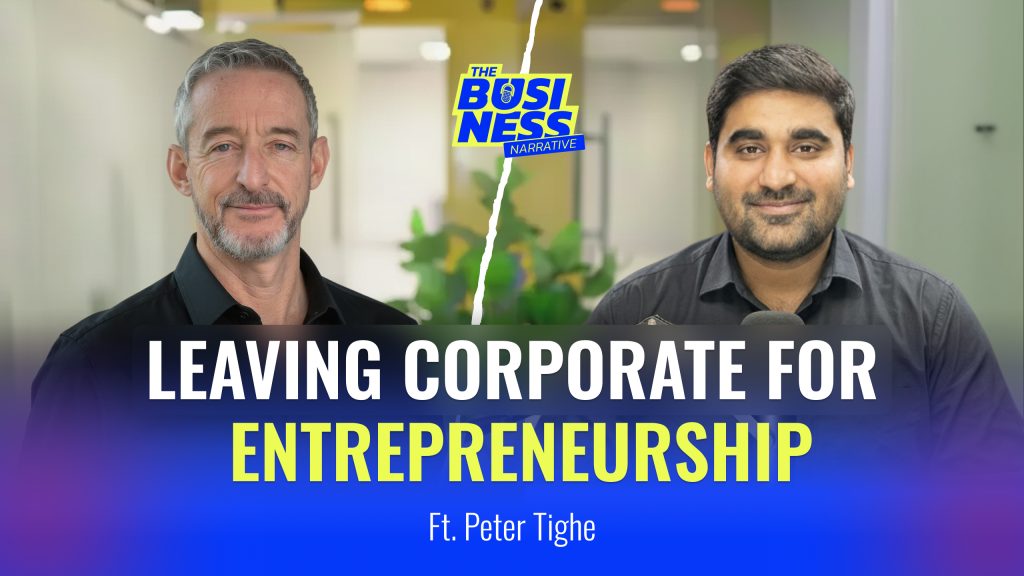
We recently sat down with Peter Tighe, Co-Founder of FundLabs and a former executive at L’Oreal. After a 20-year corporate career and exiting a £400 million business, Peter shared the unfiltered truth about leaving the corporate safety net, executing the perfect investor pitch, and why youth is actually highly overrated in the startup world.
Here is exactly what it takes to survive the jump.
What is the best age to start a business?
The best age to start a business is actually 40 and older. While young founders get media hype, older entrepreneurs possess the foundational industry experience, emotional resilience, and professional networks required to successfully scale a company and navigate the grueling realities of early-stage startups.

The Corporate System vs. The Startup Grind
When you work for a multinational organization like L’Oreal, you are shielded by systems. You have cash flow security, marketing budgets, and massive support structures. This allows you to focus on a very constrained, limited box of execution.
When you become an entrepreneur, that box shatters.
- You wear every hat: In the early days, you are the CEO, the product developer, the marketing team, and the janitor.
- The feedback is visceral: In a corporate setting, a customer complaint goes to a department. When it’s your startup, a complaint feels entirely personal.
- Speed is your only leverage: You don’t have time for endless committee meetings. If you don’t go to market quickly, you die.
Corporate life is an incredible training ground. It exposes you to different cultures, business models, and scale. But entrepreneurship grounds you in reality.
3 Steps to Master the Investor Pitch
If you survive the early days and are ready to scale, you will eventually need capital. Peter has seen hundreds of pitches and helps founders transition from $2 million to $10 million in revenue.
Here are the three non-negotiable elements you need in the presentation room:
1. Why Should Anyone Care? (The Problem) Ideas are absolutely worthless. Execution is everything. Do not get bogged down in the features of your SaaS product. Start your pitch by clearly defining the acute pain point your target audience has. If you can’t prove there is a painful problem that people are willing to pay to solve, the pitch is over.
2. Prove Your Minimum Sellable Product (The Traction) Investors don’t want to hear about what you might build. They want to see what you have already sold. A Minimum Sellable Product proves that people are saying, “I’m in.” It shows you have real-world feedback on what works and what doesn’t. Clarity of traction beats a polished slide deck every time.
3. Why Are You The One? (The Founder) At the early stage, investors are betting on the jockey, not the horse. They want to know why you have the unique skills, the resilience, and the team to make this happen. You are selling your adaptability. As you scale, they will buy into your business systems, but at the start, they are buying into you.
Stop Thinking, Start Doing
You cannot think your way into a successful business. You only learn by doing. If you launch a product and it fails, it’s not a big deal. You take the lesson, adapt your go-to-market strategy, and move on to the next iteration.
Whether you are trying to raise $200,000 for an MVP or selling a company for $400 million, the game is exactly the same: Find the right buyer, adapt to their target market, and sell the value they are looking for.
Want to hear the full story and get deeper insights into scaling your business? Go to YouTube and listen to the complete podcast episode with Peter Tighe here: Podcast.
(Check out our TBNto see more Blogs)


![Why Your Mouth Is the Ultimate Gateway to High Performance [2026 Guide]](https://thebusinessnarrative.net/wp-content/uploads/2026/09/Podcast_Thumbnail_94-1.jpg)
