
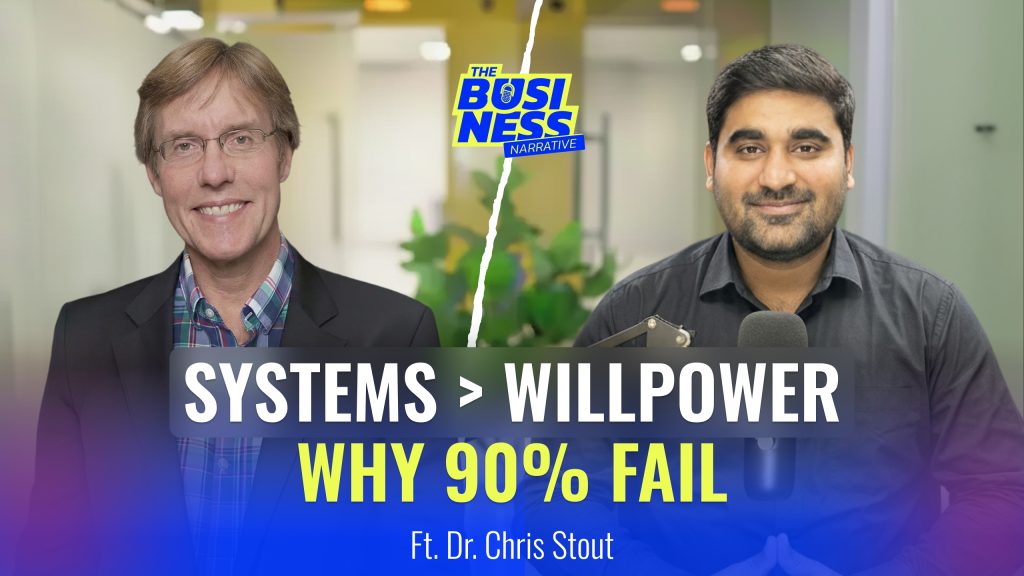
90% of startups fail. Let that sink in. Most founders think they’re the exception—the “unicorn” that will defy the odds through sheer grit and a revolutionary idea. But as Dr. Chris Stout, a licensed clinical psychologist and startup advisor, explains, that very enthusiasm is often what leads to the “valley of death” between years two and five.
If you want to be in the 10% that survive, you have to stop relying on biological willpower and start engineering architectural systems.
Want to hear the full story? Go to YouTube and listen to the podcast episode here: PODCAST
What is the Unicorn Delusion?
The Unicorn Delusion is a cognitive bias where early-stage founders believe their product is so unique that they face no competition. In reality, the absence of competitors usually signals a lack of market demand. Research shows that 42% of startups fail simply because there is no real market need for what they built.
You shouldn’t fear competition; you should fear its absence. Competition is proof that someone is already “plowing the field” for you.
Why Systems Are More Important Than Willpower
We love the myth of the “heroic founder” who works 100-hour weeks on pure adrenaline. But psychology tells a different story. Willpower is a finite resource—it’s a muscle that gets tired, especially under the chronic stress of scaling a business.
When your “willpower muscle” fatigues, you make bad decisions. High-performing founders replace willpower with Entrepreneurial Success Systems:
- The 10-80-10 Rule: You provide the first 10% (vision) and the last 10% (refinement). Your systems and team handle the middle 80%.
- Standard Operating Procedures (SOPs): Don’t solve the same problem twice. Document the solution so you can delegate it.
- Energy Management: Stop tracking time; start tracking energy. Schedule your high-impact work during your cognitive peaks.
The Psychological Impact of AI on Leadership
AI is changing the game, but not just in your workflow. It’s creating an identity crisis for leaders. If you’ve spent your career being “the smartest person in the room,” what happens when an LLM can draft your strategy in seconds?
Dr. Stout suggests treating AI as an “Intelligent Intern.” You must supervise it, guide it, and fact-check it to avoid “hallucinations,” but you should offload the systematic, routine tasks to it immediately.
The leaders who thrive in 2025 won’t be the best at data processing; they’ll be the best at relational intelligence and navigating ambiguity while the machine handles the “widgets”.
Bootstrapping vs. Venture Capital: The Equity Trap
Should you take the check or build it yourself? It depends on your speed requirements.
- Venture Capital: Good for big, scalable ideas that need to capture a market fast. But remember: VCs expect 60% of their portfolio to go to zero. You are part of their diversification strategy, not their priority.
- Bootstrapping: Dr. Stout points to successes like Prevail Health, which stayed independent for 14 years. By using government grants (like SBIR) and customer pre-funding, you keep 100% of your equity and 100% of your soul.
Early Warning Signs Your Startup is Failing
Startups don’t usually die in a day; they erode over time. Watch for these red flags:
- Founder-CEO Gap: You love the product but hate managing the people. If you neglect the culture, “back-fighting” and “sniping” will kill your momentum before the market does.
- The “Quick Flip” Mentality: If you’re building to sell to Private Equity (PE), beware. Many PE firms prioritize short-term profit through layoffs, which can destroy the reputation you spent years building.
- Regulatory Blindness: In sectors like healthcare, having a “great app” isn’t enough. If you don’t understand the “gatekeepers” (like insurance reimbursements or the Illinois WOPR Act for AI in therapy), you’re dead on arrival.
The Bottom Line
Success isn’t about how hard you can push; it’s about how well your systems can pull. If you’re still relying on your own willpower to keep the lights on, you’re not building a business—you’re building a burnout machine.
Want to hear Dr. Chris Stout’s full breakdown on the “Dangerous Founder” and how to train your brain for ambiguity?
Go to YouTube and listen to the podcast episode here: PODCAST
(Check out our TBNto see more Blogs)


![Why Your Mouth Is the Ultimate Gateway to High Performance [2026 Guide]](https://thebusinessnarrative.net/wp-content/uploads/2026/09/Podcast_Thumbnail_94-1.jpg)
